Short Drama Editing Cost Breakdown: How Industrialized Processes Save 30% of the Budget?
The short drama is booming, but making money isn't necessarily easy.
The short drama is booming, but making money isn't necessarily easy. For a 60-episode vertical short drama, beyond actors, locations, and equipment, the editing phase is often a hidden money pit. Rough cuts, fine cuts, subtitles, voiceover, multi-platform version adaptation, repeated revisions... a single editor can produce at most 2–3 finished episodes per day, and the editing cycle for an entire drama often takes weeks. Labor costs easily account for over 40% of the total post-production budget.
What's even more frustrating is that short drama editing involves a large amount of repetitive labor: every episode requires adding subtitles, color grading, applying uniform opening and closing credits, and exporting in different aspect ratios. These tasks don't require much creativity but consume the most time and manpower. If these steps can be industrialized and automated, the budget can be genuinely reduced.
Batch editing tools like Vibbit are precisely the key to moving short drama editing from an "artisanal workshop" to a "semi-automated assembly line." Below, we break down the cost structure of short drama editing and see how industrialized processes can save 30% of the budget.
The essence of saving money in short drama editing is to hand repetitive, mechanical tasks to tools, allowing limited human resources to focus on the fine cutting and creative judgment that truly create value. Through an industrialized process of "templating + automation + data feedback," unit costs are systematically reduced.
The 30% saved does not come from squeezing working hours, but from eliminating ineffective labor.
1. The Cost Black Hole of Short Drama Editing: Hidden Repetitive Labor Eats the Budget
Let's do the math first. Suppose a 60-episode short drama, with each finished episode lasting 2 minutes. A skilled editor takes an average of 3–4 hours to complete rough cutting, adding subtitles, voiceover, color grading, and exporting. Based on a daily rate of 800 yuan, the labor cost per episode is about 300–400 yuan, and 60 episodes amount to 18,000–24,000 yuan. This does not even include the extra time for revisions, rework, and multi-platform adaptation.
Among these tasks, the parts that truly require "creativity"—such as pacing control, emotional emphasis, and shot selection—may only account for 30% of the workload. The remaining 70% is mechanical work: adding uniform subtitles, applying fixed transitions, adjusting aspect ratios, exporting different formats, and replacing opening and closing credits. These steps are precisely the cost black hole: they must be done, but they do not require human labor at all.
The value of Vibbit lies in compressing that 70% of repetitive labor to near zero.
2. Templating: Turning Each Episode's "Formula" into a Reusable Asset
Although the plot of each episode differs, the editing "skeleton" of a short drama is highly consistent: opening hook, narrative body, emotional climax, and closing cliffhanger. Subtitle styles, transition rhythm, background music, and brand watermark—these elements are uniform throughout the entire drama.
Vibbit allows you to create drama-specific templates and preset these fixed elements once. Opening and closing credits, subtitle positions, font colors, transition duration, and BGM volume are all locked into the template. Editors only need to import each episode's raw footage and dialogue text, and the system automatically applies the template to complete the rough cut framework.
The fixed operations that previously required manual dragging for every episode are now a one-time configuration, reused across the entire drama. Assuming a 60-episode drama, saving 40 minutes of template application time per episode adds up to 40 hours—equivalent to a full week's workload for one editor. That is the first lever for saving money.
3. Automated Subtitles and Voiceover: Eliminating the Most Expensive Manual Step
Subtitles and voiceover in short dramas are the most time-consuming and costly parts of post-production. The traditional process involves manually transcribing dialogue, syncing timecodes line by line, adjusting styles, and then hiring voice actors or recording in-house. For a 2-minute episode, subtitle production takes at least 1 hour, with voiceover on top.
Vibbit's automatic subtitle feature can directly read dialogue text and automatically generate dynamic subtitles with precise timecodes, supporting batch processing across all episodes. You only need to provide the dialogue documents for each episode, and the system automatically matches speech to visuals, with uniform subtitle styles. The accuracy is sufficient for regular dialogue; occasional slips or dialect can be manually fine-tuned afterward.
For voiceover, Vibbit includes multiple AI voices, allowing you to select different timbres based on character gender and age, with automatic speech synthesis. Although AI voiceover cannot yet fully replace professional voice actors in emotional expression, for budget-constrained short drama teams—especially for ad-style short dramas and commentary-style dramas—the result is already usable. The key is cost: AI voiceover costs less than one-tenth of human voiceover.
Together, these two items can save 1.5–2 hours of labor per episode, which translates to 150–200 yuan at a daily rate. Across 60 episodes, that saves nearly 10,000 yuan.
4. Multi-Platform and Multi-Aspect-Ratio Generation in One Go: One Set of Assets Covers All Channels
Short drama distribution is fragmented: Douyin, Kuaishou, WeChat Channels, Bilibili, iQiyi, Youku... different platforms require different aspect ratios and duration versions. In the traditional workflow, editors need to output a separate version for each platform, readjusting composition and subtitle positions, multiplying the workload.
Vibbit supports outputting 9:16 vertical, 1:1 square, and 16:9 horizontal versions from the same template simultaneously. The system intelligently crops based on the main subject, ensuring characters and key information always stay within the safe area and are never cut off when switching aspect ratios. Subtitles also automatically adapt to safe-area positions for different ratios.
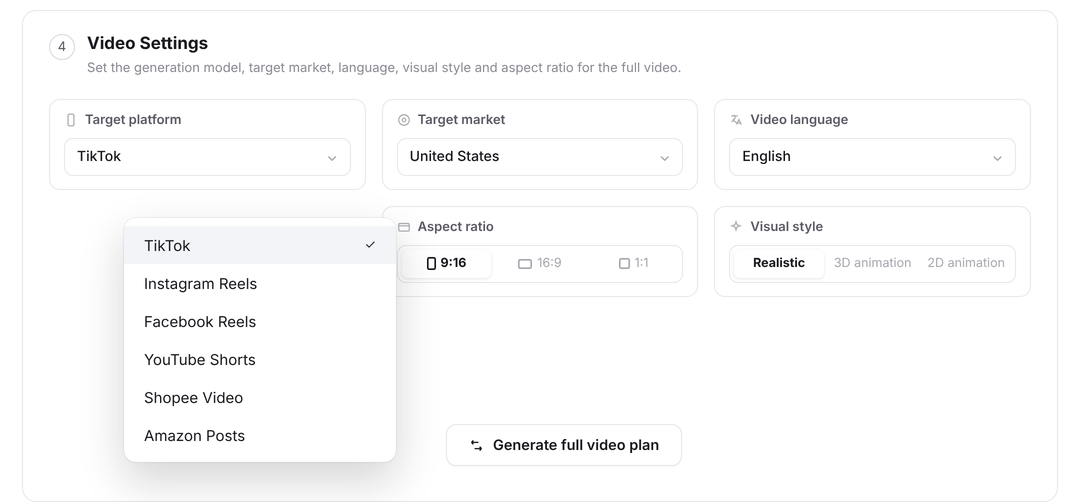
This means editors only need to complete one fine cut, and Vibbit automatically generates all the versions required by different platforms. For a 60-episode drama, assuming coverage of three platform aspect ratios, the traditional workflow would require outputting 180 versions, with each version taking an extra 20 minutes to adjust—60 hours in total. Vibbit reduces that time to zero. What is saved is not only labor costs but also the risk of publishing delays and rework caused by version confusion.
5. Data-Feedback-Driven Fine Cutting: Spending Money Where It Matters Most
The core logic of an industrialized process is "batch produce first, then optimize based on data." After a short drama goes live, each episode's completion rate, drop-off points, and conversion data will tell you where the problems are. In the traditional workflow, revising one episode means reopening the project file, readjusting, and re-exporting. But in Vibbit's system, a revision is simply updating the template or replacing assets.
For example, if data feedback shows an excessively high drop-off rate in the first 3 seconds, the team can prepare 5 different opening hooks, use Vibbit to batch generate 5 test versions, and quickly publish them to a small traffic pool for testing. Whichever opening achieves the highest completion rate can then be batch-applied to all episodes of the entire drama. The entire process does not require editors to manually modify episode by episode—Vibbit completes the new version output for all 60 episodes within minutes.
This rapid trial-and-error capability avoids the catastrophic rework of discovering pacing problems only after the entire drama has been edited. Rework is one of the biggest culprits of budget overruns. Using data feedback to drive fine cutting is equivalent to reducing revision costs from "re-editing the entire drama" to "partial replacement," and the savings far exceed expectations.
6. The Bottom Line of Industrialized Processes: Where the 30% Budget Savings Come From
Adding up the savings from each step above reveals where the 30% budget reduction comes from:
Templated fixed operations: saves about 20% of editing working hours
Automated subtitles and voiceover: saves about 25% of subtitle and voiceover costs
One-time multi-aspect-ratio generation: saves about 15% of multi-version output costs
Data feedback reducing rework: avoids about 10%–20% of potential rework waste
Taken together, after adopting Vibbit's industrialized workflow in the editing phase, the overall post-production budget can be reduced by about 30%. More importantly, the cycle is significantly shortened—a 60-episode drama can be compressed from the original 3-week editing cycle to about 1 week, allowing the team to take on more projects and further improve marginal benefits.
The money saved can be invested in more critical areas: better actors, more refined sets, and more compelling scripts. The efficiency improvement in the editing phase feeds back into raising the quality ceiling of the entire drama.
Conclusion
After breaking down short drama editing costs, it becomes clear that the biggest waste is not "slow editing" but "using human time to do what machines should do." The industrialized process represented by Vibbit is essentially about reallocating human resources: letting machines handle repetition and letting people focus on creativity.
Saving 30% of the budget is not the end goal; it is about freeing the team from cost anxiety and redirecting resources to the areas that truly determine a short drama's success or failure. When editing is no longer a bottleneck, short drama teams can run faster and farther on the content track. That is the real value of industrialized processes.