From Idea to Short Drama Abroad: End-to-End Practice in AI Video Production
Taking short drama overseas is one of the hottest openings in content export right now, and also the track most prone to starting strong and fading.
Taking short drama overseas is one of the hottest openings in content export right now, and also the track most prone to starting strong and fading. Plenty of teams put the budget into one beautifully made first series and then find they cannot keep up — short drama's core competitiveness is not the finish on a single piece but producing above-the-bar content continuously, reliably and at scale. Ideas can arrive in bursts; throughput has to be online every day. Vibbit's value in this chain is not writing your scripts or giving you cinematic images. It is compressing every standardisable stage of short drama production — shot templates, caption packaging, multilingual adaptation, version derivatives — down to minutes, so the team concentrates its limited people and time on the parts that genuinely need creativity: story design and emotional pacing. Short drama abroad is a throughput war, and the value of AI tools is keeping throughput from being your bottleneck.
I. The real barrier is not ideas but sustained output
Start with the industry reality: episodes in the overseas short drama market generally run one to two minutes, and a series is usually 60 to 100 episodes, which means one project delivers over 100 minutes of finished content. The way short drama is distributed means the first five to ten episodes are test material: if the data misses, the direction changes, and a team may need several projects running at once to land one hit.
Worked through, a short drama team's monthly need may be 300 to 500 minutes of finished content. Through a traditional production process — storyboarding, casting, shooting, editing episode by episode, grading episode by episode, captioning episode by episode — that requirement flattens a small or mid-sized team.
More to the point, short drama audiences have almost no patience: miss in the first three seconds and they swipe. Every episode needs dense hooks and emotional beats, and the editing has to be fast, precise and ruthless. That requirement for high-density emotional delivery is exactly what can be templated, structured and tooled. That is where Vibbit enters.
II. Vibbit's position in the chain: turning editing into assembly
The short drama production chain runs roughly: script → storyboard → shooting and sourcing → editing and packaging → multilingual adaptation → batch publishing. Vibbit does not touch the first three. It starts at editing and packaging and strings everything after it into an automated line.
1. Templated storyboards: one episode's skeleton is reusable.
Short drama pacing is strongly typed. The first ten seconds of a rebirth-and-revenge drama are almost always the same structure: the lead is humiliated → emotional low point → hint of the turn. That structure decomposes into a Vibbit shot template: which shot size at 0–3 seconds, which transition at 3–7, at which beat the caption pushes in at 7–10. One validated hook template can be reused across dozens of episodes, or dozens of series of the same type.
Editors no longer build a timeline from scratch for every episode. They drop new material into a structure already proven to work, and Vibbit handles pace alignment, transition insertion and caption timing. The creative part — what this episode's story is — stays with people; the execution part — how to cut it to that pace — goes to the template.
2. Batch captions and multilingual versions: one episode becoming N.
The core move in taking short drama abroad is localisation. One Mandarin series going to English, Spanish, Japanese and Middle Eastern markets needs different caption languages, and sometimes culturally adapted character names and lines. Translating and burning captions episode by episode multiplies the work several times over.
Vibbit supports batch caption generation and multilingual translation, with several language caption tracks maintained in one project. Once translation is done, finished episodes export in bulk per language region. More usefully, Vibbit allows different caption styles and layout parameters per language version — Arabic needs right-to-left, Japanese needs adjusted type size — and those details are preset in each language's template.
3. Version derivatives: several cuts from one piece of material.
Distribution teams run A/B tests constantly: from the same episode, a 15-second traffic cut, a 60-second full cut and a 30-second suspense cut, each tested in a different placement. That used to mean an editor cutting three times. Vibbit's template variants let a team generate several versions of different length and pace from the same material quickly. Whichever performs gets its structure fixed as a new template, and iteration continues.
III. The workflow: one series from idea to overseas release
Step one: validate the idea and design the structure.
Before going into volume, the team settles what emotion this series sells. Vindication? Tormented romance? Mystery and reversal? Family drama? With the emotional spine settled, break out each episode's structure: at which second the first conflict must appear, at which second the emotional turn lands, what hook closes it. Those structural decisions map directly onto template parameters in Vibbit.
Step two: shooting and asset management.
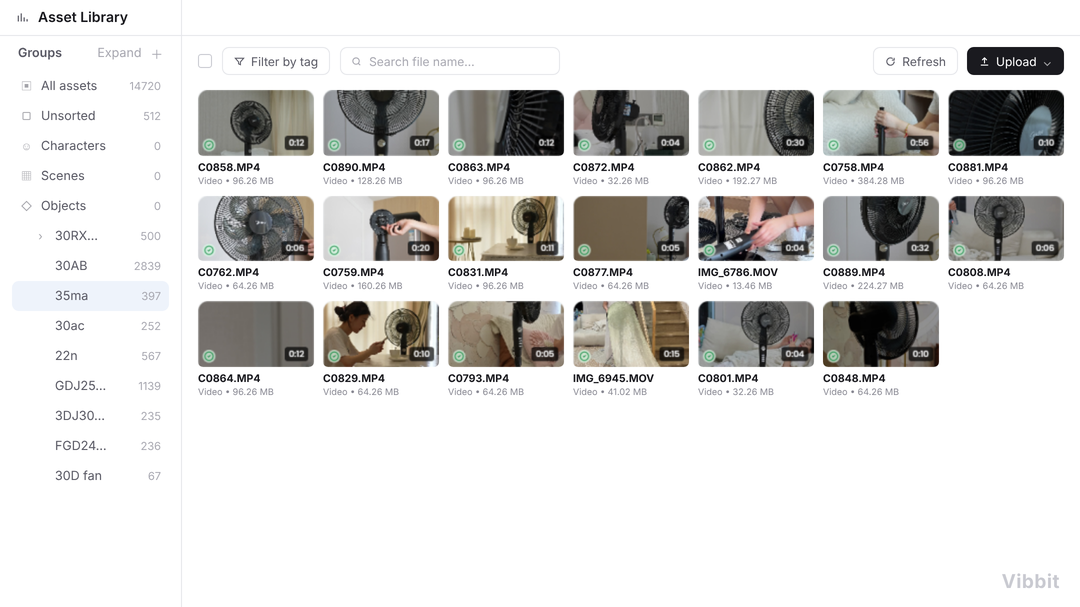
Short drama shoots are usually compressed into a few days and generate a great deal of raw material. Once in Vibbit it gets batch pre-processing: frame unification, base grading, denoising, key scenes marked. The library is tagged by episode, scene and emotion type, so editors call material up quickly instead of losing time hunting for it.
Step three: templated editing and finished episodes.
Editors assemble each episode's material into a validated template. Vibbit handles pace alignment, transitions, caption timing and music entry. A practised editor working with Vibbit can raise per-episode output three to five times. For series types with stable data performance, semi-automatic editing becomes possible — people only adjust the key beats.
Step four: localisation and version derivatives.
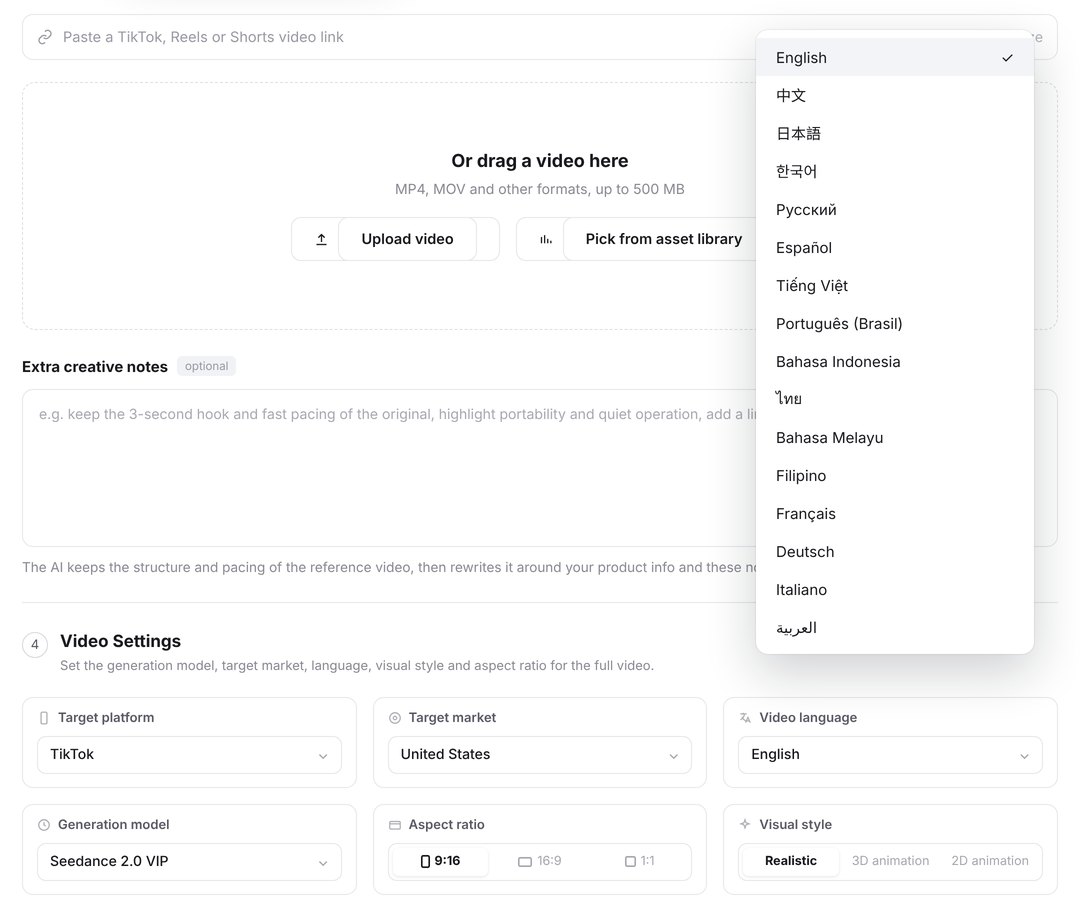
With episodes finished, localisation begins. Caption translation, multilingual export and cuts at different durations all run through Vibbit's batch flow. One series can produce combinations covering five language regions and three durations at once, with naming rules and export parameters set in advance so nothing gets confused.
Step five: release cadence and data feedback.
Short drama releases hook-first: the early episodes are pushed to test data, and completion and conversion rates decide whether later episodes get further investment. Vibbit's publishing queue helps manage release cadence across parallel series, and once data returns the team judges which structures work and which emotional beats perform, feeding that back into template iteration.
IV. What to give the AI and what must stay with people
The easiest mistake for a team taking short drama abroad is trying to have AI do everything — write the script, generate the images, do the voices, cut the edit. That route does not currently work, because the core of short drama is precise control of emotional pacing, which is exactly what AI is worst at. AI can produce 100 pieces quickly, but if the emotional pacing is wrong in each one, all 100 are waste.
The right division:
People handle: story design, character relationships, sharpening dialogue, judging emotion, reading data. These need taste, experience and an understanding of people.
AI handles: asset management, pace alignment, caption generation, multilingual adaptation, version derivatives, batch export. These have clear rules, high repetition and can be solved with templates.
Vibbit's boundary is clear: it lets you spend more time on what people handle and almost none on what AI handles. Once a team separates those two cleanly, the throughput problem is genuinely solved.
V. The endgame is industrialisation
What short drama abroad really comes down to is not which team can shoot a masterpiece but which team can turn short drama production into an industry — a steady output cadence, a controllable cost structure, reusable production modules, iterable quality standards. The logic is the same as manufacturing: a single hit is luck, sustained output is a system.
An AI video tool like Vibbit is essentially helping short drama teams build that system. It does not perform miracles, but it lets your team catch an idea when one arrives, hold up when throughput is tight and keep pace when it is time to expand. Ideas decide how fast you can run; the system decides how far. The track is long — be the team that does not fall behind on throughput.