From Idea to Short Drama Abroad: End-to-End AI Video Production with Vibbit
In the rush to take short drama overseas, most teams die in one of two places: validating the idea too slowly, so the budget is gone by the time the direction turns out wrong; or failing to keep up, so a first series that performed cannot be scaled.
In the rush to take short drama overseas, most teams die in one of two places: validating the idea too slowly, so the budget is gone by the time the direction turns out wrong; or failing to keep up, so a first series that performed cannot be scaled. Those look like a creative problem and a production problem, but they are the same problem: short drama teams lack an end-to-end system running from idea to finished episode and from test to scale. If an idea cannot become a testable episode quickly, validation is slow; if a validated structure cannot be settled into a reusable template, throughput never rises. Vibbit's role is reconnecting the link between creative and throughput that was broken: ideas define the direction, templates fix the structure, batch processing amplifies the output, and data feedback corrects the direction. The endgame is not shooting one good series but building an industrial system that keeps producing content above the bar. This article is about how to build it.
I. Two death traps: slow validation and a throughput drought
The market logic of short drama abroad is nothing like traditional film and television. A series' first five to ten episodes are essentially test material, distributed into different markets to read the response. Good data means shooting continues; bad data means changing direction immediately. That model demands two capabilities.
First, validation speed determines how efficiently budget burns. Taking an idea from planning to a shot test episode takes weeks in a traditional process. If the direction is wrong, those weeks and that production cost are pure loss. Plenty of first-time teams put the whole budget into beautifully made early episodes, miss on the test data and stall the project entirely — not because the idea was bad but because validating it was too slow and too expensive.
Second, the ability to scale after validation determines whether you can catch the traffic. If the first ten episodes perform, viewers start following and the platform starts pushing volume, throughput has to keep up. But short drama is serial: the pressure of 60 to 100 episodes is continuous. Many teams cope during testing and then, entering the scale phase, expose their bottlenecks in editing, captions and multilingual adaptation. Going quiet decays the traffic and the earlier investment is wasted.
Vibbit addresses exactly these two: accelerating validation through templated production, and supporting the scale phase through batch processing.
II. Link one: turning an idea into a testable episode fast
Before shooting, a short drama idea exists only in the writer's document. Between document and finished episode sit shooting, editing, packaging and captions. Vibbit cannot replace shooting, but it can compress everything after it to a minimum.
Concretely, the team should build a test-episode template during the idea stage: by drama type (vindication, sweet romance, mystery, family drama), preset the structural parameters — a conflict hook within the first few seconds of each episode, the transition pacing, the caption style, when the music enters. Once the idea is settled and the test episodes are shot, the template is applied directly and Vibbit completes pace alignment, caption timing and base packaging.
That compresses the validation cycle from two weeks of shooting and editing to two days of shooting and applying a template. A team can test several creative directions simultaneously in less time, retire the ineffective ones quickly on data, and concentrate budget on the projects with real potential.
III. Link two: settling validated structure into scalable throughput
Once test episodes hit their numbers, what a team needs is not to start the main series from scratch but to copy the validated structure completely into the episodes that follow. That is the core value of templates as assets.
While the test episodes were running, plenty of parameters were already validated: the form of the first-three-seconds hook, where the emotional turn lands, the rhythm at which captions appear, how the music enters. Those effective parameters should be fixed into a template rather than recreated by feel in every episode. Vibbit lets a team turn the test episodes into a standard template, so each later episode only takes filling in new material while pacing and style align with the validated version automatically.
Further, structural reuse is not limited to one series. Short dramas of the same type — vindication dramas, say — can share one validated base template. A new project starts by adjusting an existing template rather than designing from zero. That is industrial logic: do not rebuild the wheel, turn validated capability into a callable asset.
IV. Link three: multilingual adaptation and version derivatives
The revenue ceiling for short drama abroad depends on how many markets a series can cover. The same series going to English, Spanish, Southeast Asian and Middle Eastern markets multiplies returns several times over. But multilingual adaptation is enormous work in a traditional process: translating episode by episode, burning captions episode by episode, adjusting layout per language.
Vibbit's batch multilingual processing is key here. A team maintains several language caption tracks in one project while Vibbit handles translation, caption matching and multilingual export. Layout differences between languages — right-to-left Arabic, adjusted Japanese type — are preset in each language's template and never handled episode by episode.
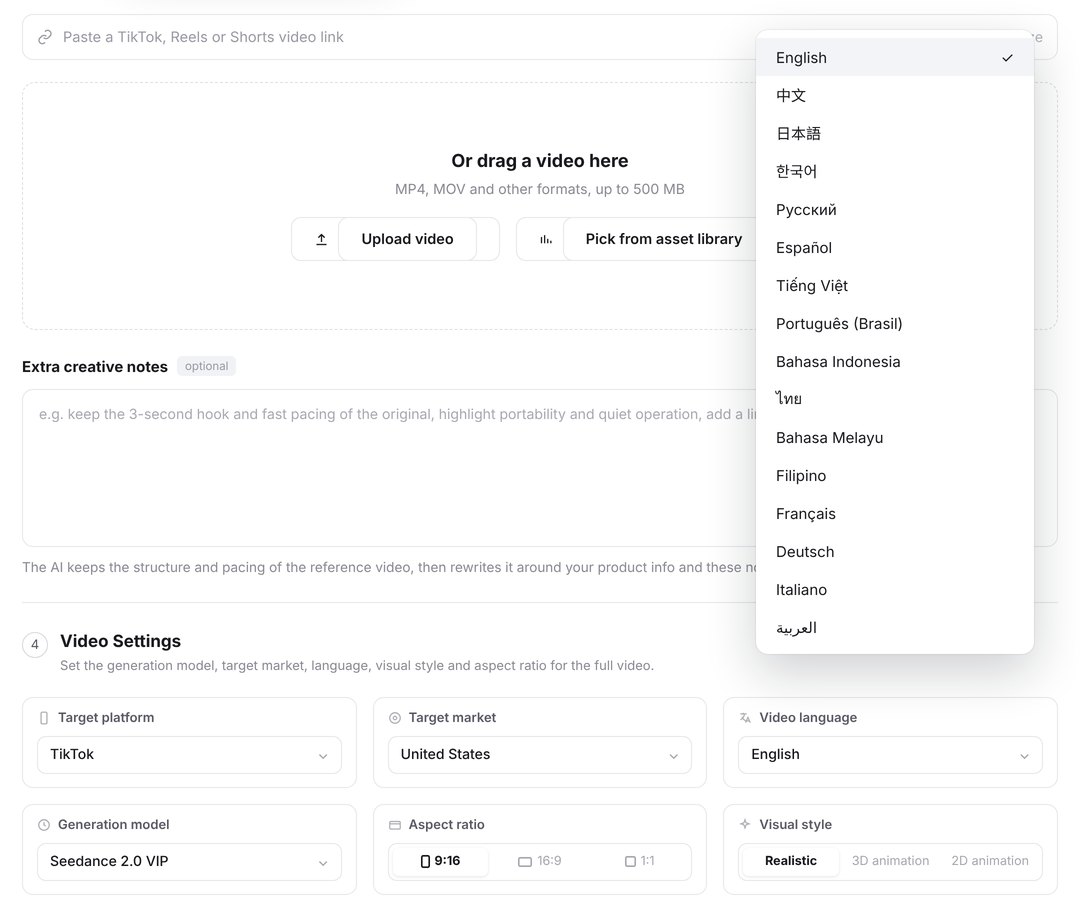
At the same time, distribution needs large numbers of traffic versions: a 15-second suspense cut, a 30-second high-energy cut, a 60-second story cut. These are not simple trims but different narrative pacing from the same material. Vibbit's template variants generate several traffic versions from the main cut quickly, testing different placements at minimal cost. A series' value goes from one finished cut to a content matrix of the cut plus N language versions plus M traffic versions.
V. The sign the chain is working: from project-based to system-based
When a short drama team genuinely gets this end-to-end chain running, the way it works changes fundamentally.
At project inception: no more writing creative proposals from zero. Pick a base structure from the type template library and differentiate on top of it. The creative focus moves from form to content — no agonising over how to cut and package, just the story and the characters.
At the test stage: with the idea settled, produce test episodes quickly, apply the type template, and complete production and distribution of test material within days. When data returns, judge whether the direction is viable, retire it fast if not, and move into main production if so.
At the scale stage: the validated structure becomes the main series template directly, and later episodes are produced in bulk. Editors move from cutting each episode from zero to filling the template and adjusting the key beats. The throughput bottleneck dissolves into templates.
At the distribution stage: the main cut derives multilingual and multi-duration versions automatically, covering many markets and channels. Data keeps returning and feeds template iteration.
At that point a team is no longer gambling on a hit project by project but running projects continuously through one system and letting data filter the winners. Hits remain probabilistic, but the system lets you run more tests per unit of time, moving the odds from luck to something you can calculate.
VI. Competition here is competition in system efficiency
Early on, this track rewards whoever spots the market opening first; in the middle, whoever's content better suits the audience; but ultimately it rewards whoever's system is most efficient. Ideas run dry, trends move on, platform policies change. Only a system that keeps turning ideas into content and data into improvement survives the long race.
Vibbit's position is clear: it is not a tool for having ideas and not a tool for making prestige pictures. It is the infrastructure that shortens the distance from idea to finished episode, compresses the cycle from validation to scale, and multiplies the value of one series. Once you have run a first series through this system, the second and third are repetitions and iterations of the same process. The final moat in short drama abroad is not the quality of one piece of work but the speed and number of projects you can run. System efficiency is the deepest moat on this track.