Batch-Producing Short Drama Clip Remixes: How Vibbit Turns a Long Series into Many Traffic-Driving Short Videos
Once a short drama goes live, the real fight for traffic has only just begun.
Once a short drama goes live, the real fight for traffic has only just begun. Rather than waiting for viewers to find the series themselves, it pays to go on the offensive: cut the most striking segments out of the show — a high-impact reversal, an emotional eruption, a stretch of suspense setup — into standalone traffic-driving short videos and push them to Douyin, Kuaishou, Xiaohongshu and the rest, so every clip becomes a traffic entry point leading viewers to the full episodes. The problem is this: a series of several dozen episodes has highlights numbering in the hundreds, and having editors find and remix them one at a time is extremely inefficient and hard to keep stylistically consistent. Vibbit's batch clip remix production is designed exactly for decomposing a long series efficiently into many short videos each capable of driving traffic on its own. It turns one series into a content matrix, replacing manual editing with systematic production.
I. The value and the pain of clip remixing: why a long series needs to become many short videos
Promotion logic for short drama differs from long video. Scrolling through short video, a user's attention lasts only seconds, and pushing the main cut directly usually produces poor completion and poor conversion. The effective approach is to cut out the segments that best spark curiosity and emotional resonance, add an attention-grabbing title and captions, and run them as traffic material. One good clip may deliver more views and more followers than the series itself.
But the pain points of clip remixing are pronounced too.
Highlights are hard to locate: a short drama may run more than two hours in total with the highlights scattered across dozens of episodes, and locating them by review is extremely inefficient.
Remixing is not cropping: lift a segment straight out of the original and the pacing may drag, with no setup or consequence given, so the viewer does not understand it and naturally does not click.
Batch output is hard: one series needs dozens or even hundreds of clips, each with standalone appeal, which is close to impossible by hand.
Multi-platform adaptation is tedious: platforms differ in ratio, caption position and cover size requirements, and adjusting repeatedly costs time and effort.
Vibbit's approach to all of this: use structured data and automation to move clip remixing from manual labour to a batch production line.
II. Vibbit's core capability: locating highlights in a long series automatically
The first step in clip remixing is finding the segments worth cutting. Vibbit offers several ways to locate highlight content.
Script data table and dialogue search. The team can import the script into Vibbit as a structured dialogue data table, where every line is associated with episode, scene, character and emotion tag. To find every high-impact line in the comeback moments, filter for dialogue tagged "comeback" or "eruption" and the system locates the corresponding timestamps. That is immeasurably faster than reviewing episode by episode.
Speech recognition and keyword search. For an older series with no structured script, Vibbit runs speech recognition across the whole thing and generates a time-coded transcript. Operations staff can search keywords directly — "kneel," "apologise," "the truth" — and the system returns every segment containing them, previewable with a click. Locating highlights goes from a needle in a haystack to following a map.
Tag-assisted filtering. As material enters the library, the team can tag scenes as conflict scenes, emotional scenes, reversal scenes. Batch filtering then circles the target segments quickly by tag combination. Need the segments where the male lead is humiliated? Combine "character = male lead," "emotion = humiliation," "setting = public," and the qualifying material lists instantly.
III. Templated remixing: giving a clip the power to drive traffic on its own
Having found the highlight, you cannot simply crop and be done. A clip that works as traffic material needs information completeness and emotional tension of its own. Vibbit's template engine is key at this step.
Suspense-first template: open with a large caption — "She never imagined what would happen the next second" — then the segment from the show, closing on a cliffhanger with a prompt to "tap the profile for the full series."
Straight-to-impact template: open on the most intense segment, grabbing attention in the first 3 seconds, selling-point overlays in the middle, a follow prompt at the end.
Emotional resonance template: built on emotional scenes, with affecting music and captions, moving the viewer and then directing them to the full story.
Reversal reveal template: show an apparently ordinary scene, then turn abruptly to reveal the truth, creating surprise.
Each template presets the opening hook, caption style, transitions, background music and closing CTA. Vibbit drops the selected highlight into the template automatically and completes the pacing rebuild and the information filling. A clip generated this way makes sense to a viewer even out of the series' context, and leads them towards the full content.
IV. Batch production in practice: from a long series to N traffic-driving short videos
Completing batch clip remix production in Vibbit usually goes in the following steps.
Step one: import the full series and build the search system. Load the complete short drama video into the Vibbit asset library, generate the speech recognition transcript, import the script data table if there is one, and tag the material. What this step achieves is turning content into assets, making every segment searchable and filterable.
Step two: filter the highlights and mark them in bulk. Following the traffic strategy, use keyword search and tag combinations to filter out the target segments — 30 high-impact reversals, say, and 20 emotional eruptions. Mark the selected segments in bulk as clip material and group them by type.
Step three: choose templates and batch-generate the clips. Pick the right remix template for each group and bind the corresponding title copy, CTA copy and tag fields. Vibbit processes in bulk in the cloud, completing segment splicing, hook addition, caption generation, music matching and transition insertion. One render produces dozens of structurally complete traffic-driving short videos.
Step four: multi-platform adaptation and cover generation. Rendering outputs the different ratio versions automatically (9:16, 1:1, 16:9), with caption position adjusted automatically to each platform's presets. At the same time, the system extracts a high-quality frame from each clip and applies the cover template to generate the cover for every platform. Videos and covers correspond one to one and can be uploaded directly.
The core of the whole flow: organise once, reuse many times; filter once, produce in bulk; one template set, one consistent style.
V. Multi-platform distribution and cover optimisation: making clips into traffic entry points
The ultimate purpose of clip remixing is traffic, so every clip needs optimising for the platform it runs on. Vibbit provides two key supports here.
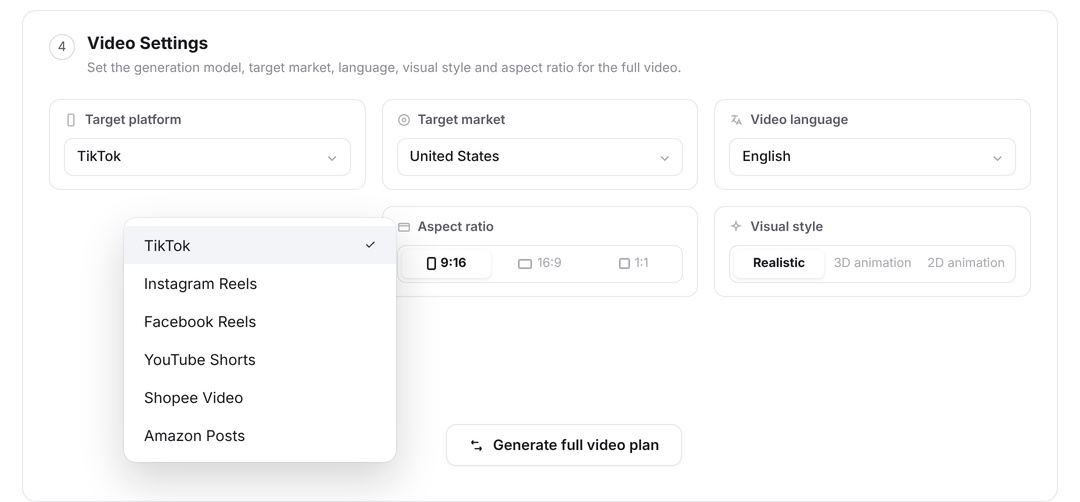
Automatic multi-ratio adaptation. Douyin and Kuaishou prefer 9:16 vertical, Xiaohongshu supports 3:4 and 1:1, Bilibili may use 16:9. Vibbit's intelligent framing identifies the subject in frame and keeps the people and the key information when cropping, so a simple centre crop does not ruin the composition. Caption safe areas also shift up automatically to each platform's presets so nothing is covered by UI.
Batch cover generation. The cover drives click-through. Vibbit shortlists the sharpest, most emotionally charged frames from each clip as cover candidates and supports designing a consistent cover template carrying the series name, an episode tag and suspense copy. During batch rendering the cover text is substituted automatically and output at each platform's size. Every clip then has a professional cover with no manual work.
VI. Clip remixing is really efficient reuse of content assets
Short drama clip remixing is not about cutting a long series short. It is secondary development of a content asset. Every clip is an independent traffic entry point, and together they form a traffic matrix that draws viewers to the original series from different angles and different emotional hooks. Vibbit's value is that it moves that secondary development from the workshop to the production line — highlights can be located fast, remix templates guarantee a quality floor for every clip, and batch rendering produces dozens of videos simultaneously in minutes.
In the competition to promote short drama, the real efficiency advantage is not how strong your editing team is but whether you can release the full content value of a series. Vibbit turns clip remixing from a craft a few people have into systematic throughput, so every long series can be decomposed into hundreds or thousands of traffic-driving short videos that reach potential viewers again and again across the traffic pools. Once the reuse efficiency of content assets becomes the core competitive capability, a team can genuinely shift its attention from how to make clips to which clips to make, driving content strategy with data and achieving sustainable traffic growth in short drama.