Behind the Explosive Growth of Short Dramas Going Global, the Editing Stage Is Being Redefined: Breaking Down Three Hidden Bottlenecks
Examine localization, character consistency, and creative testing bottlenecks as short drama editing evolves into a scalable production workflow.
Short drama going global is one of the rare structural opportunities in the content industry in recent years. A group of Chinese teams have replicated domestically proven short drama models in overseas markets, rapidly scaling up in North America, Southeast Asia, Japan, and other regions, giving rise to a sizable new track.
But the boom of short drama going global has also brought a long-neglected issue to the surface: when content demand shifts from "a small number of high-quality pieces" to "large-scale supply across multiple languages, many episodes, and high-frequency updates," can the traditional editing process still support it? The answer is becoming increasingly clear—no.
Editing, a stage once regarded as "post-production," is being redefined in the wave of short drama going global. It is not becoming simpler, but more complex; not more marginalized, but more critical. This article attempts to break down three hidden bottlenecks in the editing process that are easily overlooked in the context of short drama going global, and explore how AI tools are changing the underlying logic of this stage.
I. The Essence of Short Drama Going Global: The Industrial Transformation of Content Production
To understand the changes in the editing stage, one must first understand the commercial nature of short drama going global.
Short dramas are not simply shortened versions of traditional film and television series, but rather a form of fast-moving content consumer product. Their business model is built on three core elements: low cost, rapid trial-and-error, and scalable replication. A short drama costs far less to produce than a traditional series, but it needs to be produced and launched extremely quickly, adjusted rapidly based on user feedback, and then used to fill the demands of different markets with a large volume of content.
The demands this model places on the production side are completely different from the traditional "project-based" approach in the film and television industry. The project-based approach pursues meticulous refinement of a single work, while short drama going global pursues the stable output capacity of a content supply chain. In this supply chain, editing is no longer a technical step in post-production, but a core node that determines content production capacity and iteration speed.
However, most teams entering the short drama going global track still follow traditional editing mindsets and processes. This gives rise to three hidden bottlenecks.
II. Three Hidden Bottlenecks: Underestimated Structural Contradictions
Bottleneck 1: Multilingual Localization Is Not a Translation Problem, but a Production System Problem
Many teams, when planning short drama going global, regard multilingual adaptation as a simple overlay of "subtitle translation + dubbing replacement." But in actual execution, the complexity of multilingual localization far exceeds expectations.
Short dramas with live actors on camera involve multiple differences across languages, including lip-sync, speech rate and rhythm, and emotional expression. When a Chinese line is translated into English, the length may change, lip movements no longer match, and the rhythm is disrupted; the same scene may require re-adjusting edit points for dubbing in different languages. If a short drama has 60 episodes and covers 8 languages, the actual number of video versions to be processed is 480, not 60.
The hidden nature of this bottleneck is that it does not add workload to a single step but inserts a multiplier factor throughout the entire production process. Costs and timelines estimated in the early stage based on a single-language version are quickly amplified as the number of languages increases. By the time the problem is discovered, it is often already in the distribution stage, making rework extremely costly.
The deeper issue is that multilingual adaptation exposes not just a cost problem, but a flexibility problem in the production system. Traditional editing workflows are designed for a single language and a single version, and lack the ability to process multiple languages in parallel. To solve this problem, what is needed is not adding more people to the existing process, but redesigning the production system.
Bottleneck 2: Character Consistency and Batch Output Are Fundamentally a Difficult-to-Reconcile Contradiction
The continuity of short dramas requires that character appearances remain highly consistent across every episode and every scene. However, the need for high-frequency updates and batch output demands that the editing process produce as quickly and as much as possible.
In traditional editing workflows, character consistency relies on manual checks: whether hairstyles are the same, whether costumes reveal continuity errors, whether lighting is continuous, and whether movements connect properly. In the case of many episodes and many scenes, this frame-by-frame checking is extremely labor-intensive and error-prone. The number of shots a single editor can handle per day is limited. If they slow down to ensure consistency, overall production capacity decreases; if they speed up by reducing checks, consistency suffers.
The root of this contradiction lies in the fact that traditional editing is a "linear craft," while short drama going global requires "industrialized production." The characteristic of craftsmanship is slow, meticulous work, but it cannot be scaled; the characteristic of industrialized production is standardization and replicability, but traditional editing workflows lack the tooling foundation to achieve industrialization. Teams fall into the dilemma of "ensuring quality means sacrificing quantity, and ensuring quantity means sacrificing quality." The fundamental reason is not that people are not working hard, but that production tools and methods are mismatched with demand.
Bottleneck 3: High Creative Trial-and-Error Costs Are Stifling Content Innovation
A notable characteristic of the short drama market is that user preferences are highly uncertain and change extremely rapidly. Users in different regions have vastly different preferences for themes, pacing, and payoff points. A plot that goes viral in Southeast Asia may have no response at all in North America. Therefore, the key to success in short dramas lies in rapid trial-and-error and rapid iteration.
However, under the traditional production model, every creative direction tested requires going through the complete process of scripting, shooting, editing, and dubbing again. If a short drama tests three plot directions, the cost is tripled. If multiple episodes need to be produced for testing in each direction, the cost multiplies even further. This high trial-and-error cost makes teams conservative in creativity, tending to replicate proven formulas rather than try new possibilities.
What is even more alarming is that this conservative tendency can form a vicious cycle: the more conservative the creativity, the more homogeneous the content; the more homogeneous the content, the faster user aesthetic fatigue sets in; the faster users churn, the more reluctant teams are to take creative risks. Ultimately, the entire track may fall into a predicament of "low-level repetition."
The hidden nature of this bottleneck is that it does not manifest directly as low editing efficiency, but as a decline in the overall competitiveness of the content. The team is indeed continuously producing, but the works lack differentiation and find it difficult to stand out in a crowded market.
III. Redefining the Editing Stage: From "Craftsmanship" to "Systematic Production"
The common thread among the three bottlenecks above is that they all stem from the structural mismatch between traditional editing models and the demands of short drama going global. To break through these bottlenecks, merely adding more people, extending working hours, or optimizing process details is far from enough. What is needed is a fundamental redefinition of the editing stage: shifting from "craftsmanship" reliant on individual skills to "systematic production" reliant on systems and tools.
The core of this transformation is to separate the repetitive, technically demanding, and standardizable parts of the editing process from manual operations and hand them over to AI and automation tools. This shifts the editor's role from "operator" to "commander," and from "processing materials" to "designing systems."
Vibbit, as an AI-driven video creation platform, has a design philosophy that aligns with this direction. According to official public information, Vibbit integrates the complete process from planning, shooting, editing, dubbing, to distribution into one platform, using an AI Agent and 57 professional tools to achieve one-stop creation, with the core concept that "one person is a creative team." Based on its features, the following provides an objective analysis of the three bottlenecks.
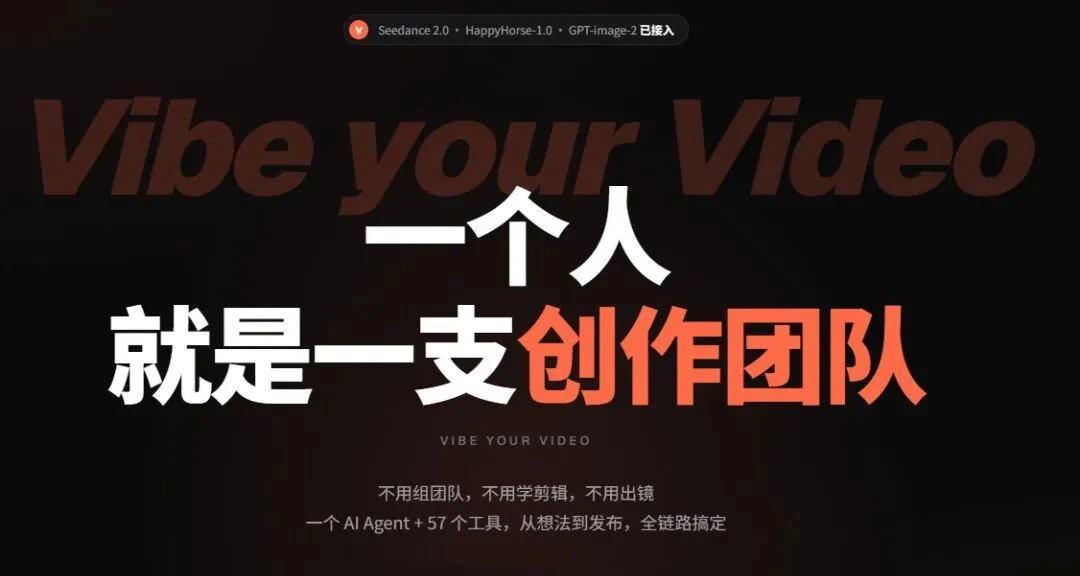
Vibbit video creation workflow, from an idea to publication.
Addressing the Production System Problem of Multilingual Localization
Vibbit provides multilingual video generation capabilities. Users shoot material once, and the system can automatically generate versions in more than 10 languages, including English, Japanese, Korean, and Southeast Asian languages, with natural lip-sync. The value of this feature lies not only in eliminating the repeated investment of multilingual shooting and dubbing but also in changing the production method of multilingual versions: from "making versions one by one" to "making once and generating multiple versions simultaneously." This parallel processing capability is difficult to achieve in traditional editing workflows.
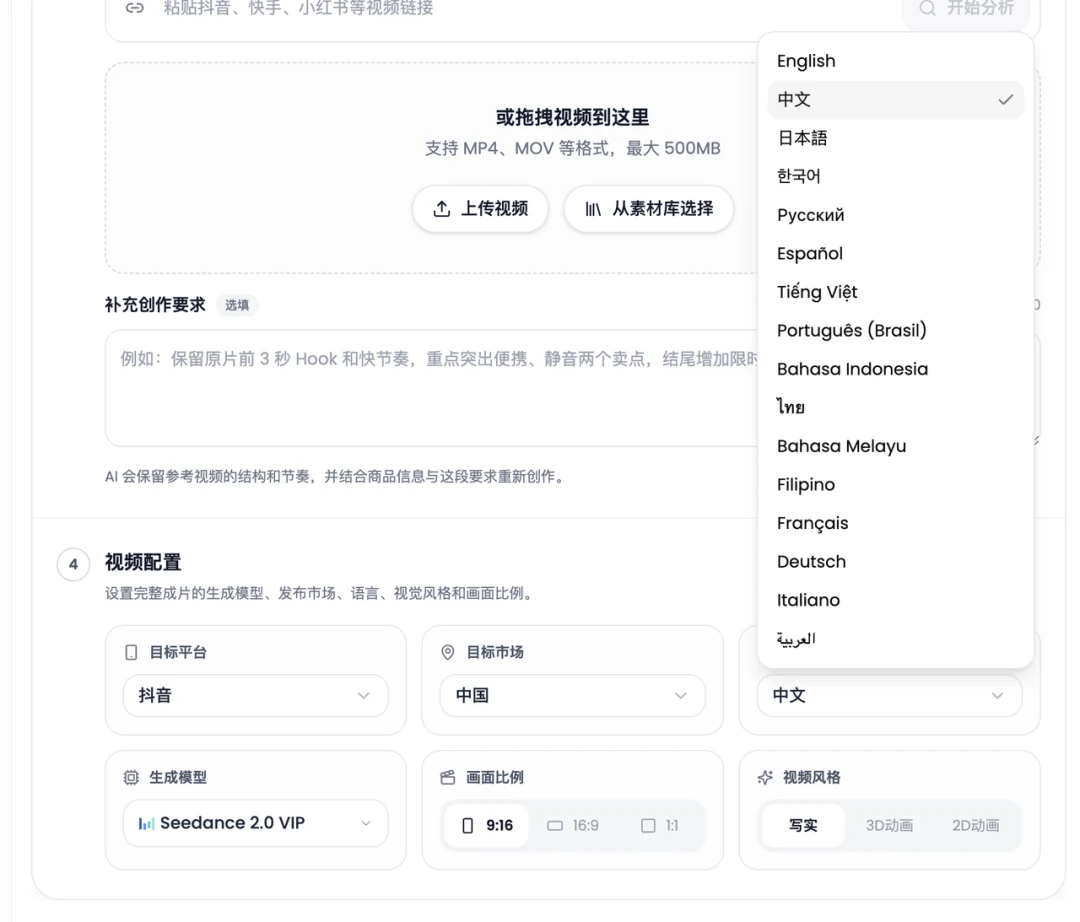
Vibbit language and aspect-ratio settings in the original Chinese interface.
At the same time, the digital human multilingual voiceover feature allows the creation of an AI digital human avatar and automatically switches between multiple languages for voiceovers. This partially bypasses the physical limitations of live actors in multilingual scenarios, providing a relatively controllable multilingual solution for short drama going global.
Addressing the Contradiction Between Character Consistency and Batch Output
Vibbit supports a character consistency feature in short drama production scenarios, allowing users to define character appearances and ensure the AI maintains consistent character images throughout the entire series. This directly addresses the common problem of "character inconsistency" in AI-generated content. In traditional editing, character consistency relies on manual checks; in the AI generation workflow, consistency can become a built-in constraint in the system.
In addition, Vibbit's fully automated "one-step video generation" capability covers the entire process from script, storyboard, visuals, to dubbing, and supports switching among multiple styles such as comic-style drama, live-action style, and 3D. This means short drama producers can batch-generate different plot content while ensuring style consistency. Its design of "batch output and rapid iteration" is aimed precisely at the core demands of industrialized short drama production.
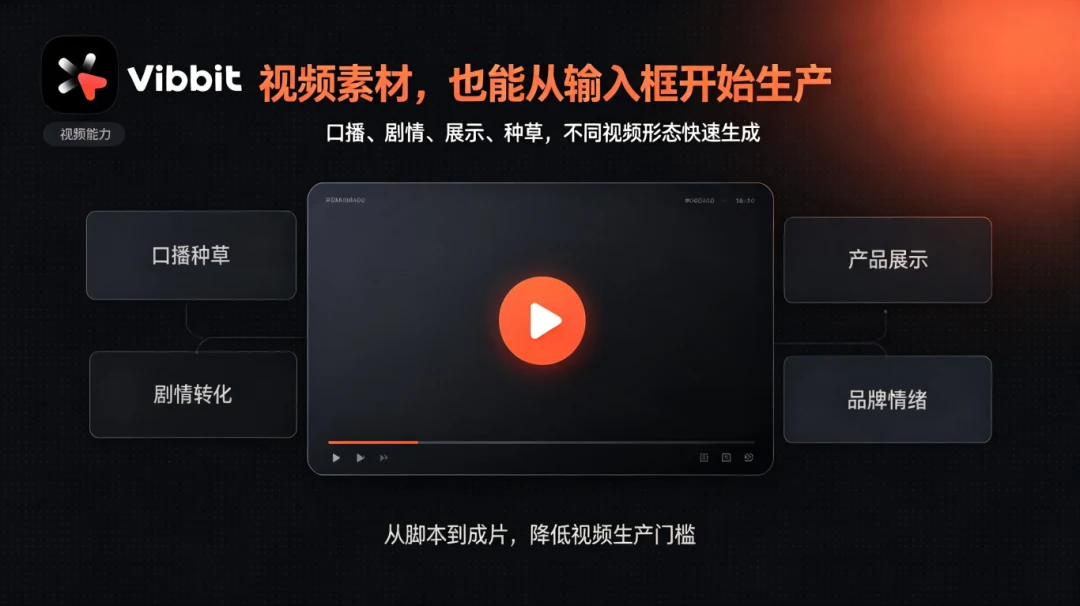
Vibbit script-to-video workflow for presentations, stories, and product demonstrations.
Addressing High Creative Trial-and-Error Costs
Vibbit provides AI script generation, allowing users to input a topic and generate a voiceover script, lowering the threshold for creative initiation. Its "Viral Teardown and Replication" feature can analyze the structure, pacing, and copy of competitor hit videos and generate videos in a similar style. It should be made clear that the purpose of this feature is not to encourage direct copying, but to help teams transform the "viral logic" from subjective experience into analyzable and reusable structures, thereby reducing trial-and-error costs.
More importantly, Vibbit's batch generation capability makes "multi-version testing" possible. Teams can produce multiple short drama samples with different plot directions in a short time, put them into small-scale testing, and decide the direction of subsequent investment based on data feedback. This model of "low-cost trial-and-error + data-driven iteration" is the key to breaking through the dilemma of creative conservatism.
IV. Deep Impact: Redefining the Editing Stage Is Changing the Industry's Competitive Landscape
When editing shifts from "craftsmanship" to "systematic production," its impact goes far beyond the production efficiency of a single team. It is changing the competitive logic of the short drama going global track.
In the past, the core barrier to short drama production was "whether you have good directors and good editors." This was a talent competition, with resources concentrated in the hands of a few teams. But when AI tools can take on most technical and repetitive work, the competitive barrier begins to shift from "talent" to "system": whoever has a more efficient content production system can produce more content at lower cost and faster speed, thereby capturing a larger share of the market.
This change does not mean that human value is diminished; on the contrary, it places higher demands on human capabilities. Editors no longer need to spend large amounts of time on technical details such as subtitles, audio syncing, and color grading. Instead, they need to devote their energy to higher-level creative work such as plot structure, pacing control, and user psychology. Human value shifts from "hands" to "brain," and from "operation" to "design."
For short drama producers, whether to adopt AI tools is essentially a strategic choice: continue competing with rivals on labor costs under the traditional model, or embrace new production systems and use technological means to build structural advantages.
V. Redefining Editing Means Redefining the Competitiveness of Short Dramas
The boom of short drama going global is, in essence, a transformation of content production methods. The traditional "craftsmanship" model of the film and television industry has exposed inherent limitations of low capacity, high cost, and slow iteration when faced with short dramas as a form of "fast-moving content consumer product." As a core node in the content production chain, the redefinition of the editing stage is already an unavoidable trend.
The three hidden bottlenecks—multilingual costs, the contradiction between character consistency and batch output, and high creative trial-and-error costs—are fundamentally conflicts between traditional editing models and the demands of industrialized production. The value of AI tools lies not in replacing editors, but in providing editors with a set of systematic capabilities that can meet the demands of industrialization.
In the competition of short drama going global, teams that adopt new production tools and build new production systems early are likely to gain structural advantages over traditional competitors. Once this advantage is formed, latecomers will find it difficult to catch up. Because tools can be copied, but the production system and team capabilities built on top of those tools are the real barrier.
The redefinition of the editing stage may well be one of the most noteworthy structural variables in this short drama going global race.