The "Industrialization" Wave in the Short Drama Industry: Content Mass Production Capability Determines Survival
Explore how short drama teams can scale content production with standardized workflows, character consistency, automation, and rapid testing.
The short drama industry is undergoing a transformation from "workshop-style production" to "industrialized manufacturing." In the early days, short dramas could succeed through low-cost trial and error by a small number of teams. Today, as the market expands and competitors flood in, relying on one or two hit dramas alone is no longer enough to sustain long-term development. The industry's core proposition is shifting from "can we produce one good drama" to "can we produce content in batches stably, efficiently, and at low cost."
Behind this wave of industrialization lies a brutal survival logic: content mass production capability is becoming the dividing line that determines the survival of short drama teams.
I. Why Is the Short Drama Industry Bound to Move Toward Industrialization?
The content attributes of short dramas determine that they are naturally suited to industrialized production. Compared with traditional film and television dramas, short dramas have three notable characteristics.
First, they are product-oriented rather than work-oriented. The core of a short drama is to quickly satisfy users' emotional needs, with short episode length, fast pacing, and dense gratification points. It is more like a "fast-moving content product" than an artwork that requires repeated polishing. The competitive logic of fast-moving consumer goods has never been about the ultimate quality of a single product, but about stable supply and cost control.
Second, high-frequency updates are the foundation of user retention. Content on short drama platforms is consumed at an extremely fast rate. Once users form the habit of following updates, their demand for update frequency becomes very high. If a drama stops updating or updates slowly, users will quickly churn. This requires producers to have sustained output capability, rather than "finishing one drama before thinking about the next."
Third, multi-market and multilingual distribution amplifies demand. After short dramas expand overseas, the same content needs to be adapted to multiple language markets. If each language version is produced separately, the workload will multiply. Only through standardized and automated production processes can the same content be efficiently converted into multilingual versions and production costs be spread out.
Together, these characteristics make it impossible for the short drama industry to remain at a stage dependent on personal experience and manual production. Industrialization is not a choice, but a necessity for survival.
II. The Structural Dilemma of the Traditional Short Drama Production Model
Traditional short drama production follows the "project-based" model of the film and television industry: first write the script, then find actors and scenes for shooting, then edit, dub, and handle post-production, and finally distribute. This process can work for a single drama, but when faced with large-scale demand, it exposes three structural dilemmas.
Dilemma 1: Long production cycles. The cycle from project initiation to launch for a short drama is usually measured in months. Market demand changes rapidly, and user preferences vary greatly across regions. A long production cycle means teams find it difficult to respond quickly to market changes.
Dilemma 2: High labor costs. Traditional production requires professionals across multiple stages, including screenwriters, directors, actors, cinematographers, editors, and voice actors. For small and medium-sized teams, the cost pressure of maintaining such a complete team is enormous, and the production capacity ceiling is limited by team size.
Dilemma 3: Difficulty in batch replication. After one drama succeeds, teams hope to quickly replicate the successful model, but traditional production processes are difficult to standardize. Scriptwriting depends on personal inspiration, shooting depends on repeated coordination of actors and scenes, and editing depends on manual processing one by one. Each new drama almost starts from scratch, making true batch replication impossible.
The essence of these dilemmas is the contradiction between the "industrialization demand" of short dramas and "artisanal workshop-style production." To break through the dilemma, fundamental changes must be made to the mode of production.
III. Core Elements of Industrialized Content Mass Production
The core of industrialization is to break down the production process into standardized steps, and use tools and systems to replace repetitive manual labor. For the short drama industry, industrialized mass production requires the following capabilities:
- Standardized production processes. Break down script, storyboard, visuals, voiceover, and other steps into reusable modules, reducing reliance on personal experience at each stage.
- Automated content generation. Use AI technology to handle repetitive and technical tasks, such as visual generation, voice synthesis, and editing, significantly shortening the production time of each episode.
- Batch output and rapid iteration. Quickly generate multiple versions or different plot directions of content around the same IP or similar themes for market testing and rapid optimization.
- Consistency assurance. In the output of multiple episodes, multiple languages, and multiple versions, ensure that character appearance, visual style, and content tone remain consistent, avoiding uneven quality caused by mass production.
- Only by possessing these four capabilities simultaneously can short drama teams truly make the leap from "single-point breakthrough" to "large-scale supply."
IV. Vibbit's Role in the Industrialization of Short Dramas
As an AI-driven video creation platform, Vibbit's feature design responds to the core needs of industrialized short drama production to a certain extent. According to its public introduction, Vibbit integrates the complete process from planning, shooting, editing, and voiceover to distribution into one platform, achieving one-stop creation through an AI agent and 57 professional tools. Its core concept is "one person is a creative team." The following combines its short drama-related features to objectively analyze its possible role in industrialized mass production.
Fully automatic "one-step video generation": compressing the production cycle
Vibbit's "one-step video generation" feature for short dramas, according to the official introduction, can cover the entire process from script, storyboard, and visuals to voiceover. This means that for some short drama content, production may break free from the traditional multi-stage collaboration model, with AI automatically completing the generation of a basic version in a relatively short time. Although AI-generated content may still require manual refinement at present, its value in compressing the pre-production cycle is significant, especially for quickly producing test episodes or filling content libraries.
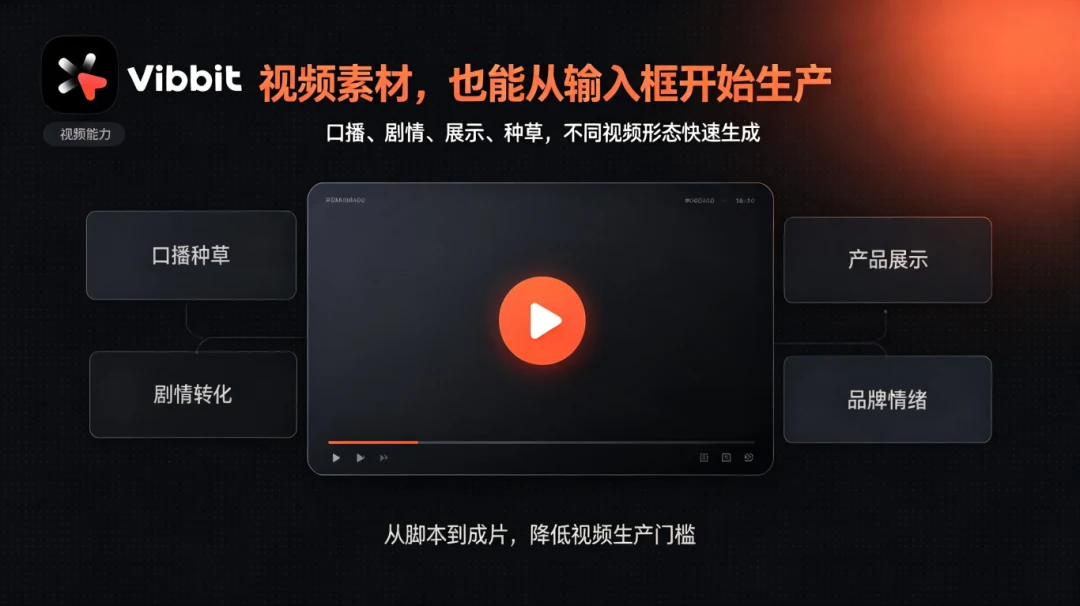
Vibbit script-to-video workflow for presentations, stories, and product demonstrations.
Unified character appearance: solving the consistency problem in mass production
Character consistency is a core difficulty in batch short drama production. Vibbit supports a unified character appearance feature, allowing users to define character appearance and ensure that AI maintains consistent character images throughout the entire drama. This capability directly addresses the common problem of "character shifting" in AI-generated content. In industrialized production, consistency is the quality baseline. If character appearance deviates in each episode, the user experience will be greatly diminished. Vibbit's feature provides a basic guarantee for mass production.
Multi-style driving: meeting adaptation needs for different genres
User preferences in the short drama market are diverse, with comic drama style, live-action style, 3D, and other styles each having their own audiences. Vibbit supports multi-style driving, allowing users to switch between different styles. This means producers can choose the appropriate style according to the preferences of the target market, without having to build a separate production line for each style. This flexibility has practical value for teams that need to quickly test different genre directions.
Batch output and rapid iteration: reducing trial-and-error costs
The key to short drama success lies in rapid trial and error. Vibbit emphasizes batch output and rapid iteration capabilities, and can quickly generate videos with different plots around the same IP. This capability allows producers to produce multiple test versions in a short time, put them into small-scale validation, and decide subsequent investment directions based on data feedback. Compared with the traditional model, in which every new direction tested requires re-shooting and re-editing, this approach greatly reduces trial-and-error costs and cycles.
Long-video-to-short-video cutting: improving asset utilization
The promotion and distribution of short dramas often require a large amount of clip assets. Vibbit's long-video-to-short-video feature can automatically cut up to 20 short video clips with viral potential from a long video. For short drama teams, this means they can quickly break down a full episode into multiple traffic-driving clips for social media distribution, improving content reuse rates.
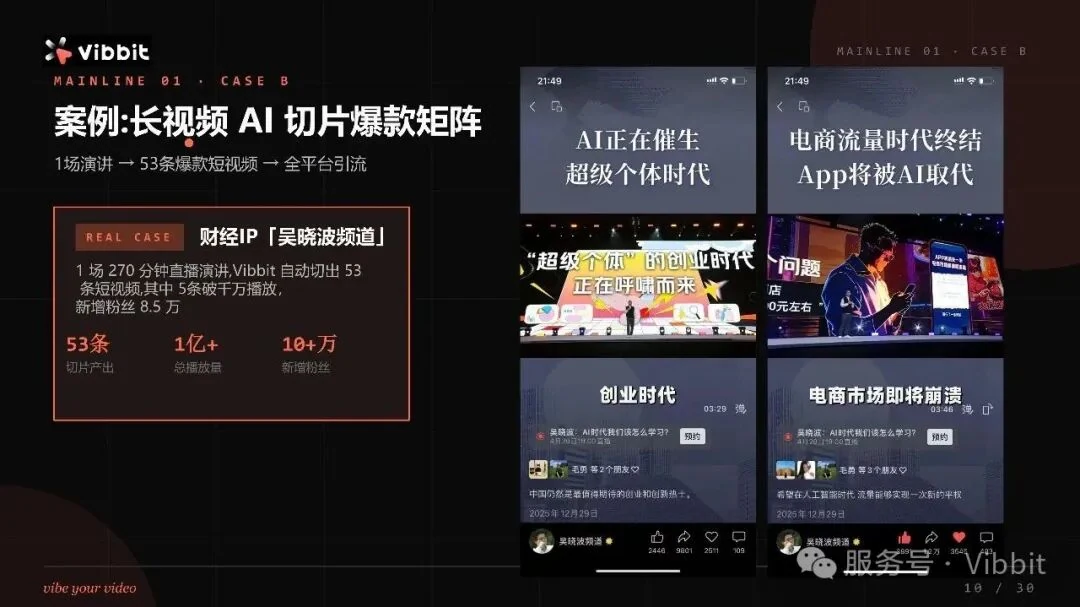
A supplied Vibbit case illustration showing clips repurposed from a long video.
V. The Industry Logic Behind Content Mass Production Capability Determining Survival
Why is it said that content mass production capability determines survival? There is clear business logic behind this.
First, cost advantage is a competitive barrier. Teams that can produce more content at lower cost can gain more exposure and user reach opportunities under the same market investment. When the industry enters a price war and traffic competition, cost advantage will translate into survival advantage.
Second, data accumulation is a moat. Industrialized production allows teams to quickly test large amounts of content and accumulate user preference data. This data in turn guides production, forming a positive loop of "testing—feedback—optimization." The stronger the mass production capability, the faster the data accumulation, and the deeper the moat.
Finally, the market window period waits for no one. The short drama industry changes extremely fast, and the dividend period for a certain genre or style may last only a few months. If a team's mass production capability is insufficient, it cannot quickly cover the market within the window period. By the time it reacts, the market will already be occupied by teams with stronger production capacity.
Therefore, content mass production capability is not just about "producing more." It is a structural advantage: it determines whether a team can survive the industry reshuffle and build long-term competitiveness.
VI. Conclusion: Under the Wave of Industrialization, Tools Are the Lever, and Systems Are the Core
The wave of industrialization in the short drama industry is irreversible. For practitioners, whether to adopt AI tools is no longer a question of "whether to use them," but "how quickly to start using them."
However, it must be made clear that tools are only a lever. The real core competitiveness lies in whether a team can build a production system aimed at mass production. This includes the reasonable application of AI capabilities, quality control of manual refinement stages, and rapid response capability to market data. Industrialization is not about pursuing "full automation," but about pursuing "systematization."
In the next round of competition in the short drama industry, content mass production capability will directly determine who can remain at the table. Those teams that take the lead in completing the industrialization transformation will gain the opportunity to define the rules of the industry, while teams that stick to traditional models may be marginalized in the new wave. The difference between life and death may well lie in the understanding and execution of the two words "mass production."