The Second Half of E-commerce Video Content Competition: From "Having Videos" to "Video Efficiency"
Explore how e-commerce teams can improve video production, cost, reach, conversion, and iteration efficiency through multilingual and batch workflows.
In the early stage of e-commerce content development, product pages only needed to "have a video" to potentially gain platform traffic support and user trust. But today, when almost all top merchants in every category already have product videos, simply "having" one is no longer enough to create differentiation. E-commerce video content competition is entering a more pragmatic and harsher stage: from "whether there is a video" to "whether the video is effective."
Here, "effective" does not only mean whether the visuals are polished, but whether the video can actually drive clicks, conversions, and repeat purchases at a reasonable cost and time investment. In other words, the core metric in the second half of e-commerce video competition is video efficiency.
I. Why Is "Having a Video" No Longer Enough?
Over the past few years, e-commerce platforms' supportive policies for video content have driven a wave of "catch-up" video adoption. A large number of merchants quickly added video materials to their products in a short period. But this has led to three obvious changes:
First, content supply is excessive, and user attention has been diluted. When every product detail page has a video, users no longer stay simply because "there is a video." Instead, they become more picky about video quality and information density. A rough, lengthy video with unclear selling points may cause more user loss than having no video at all.
Second, platform algorithms now place greater weight on engagement metrics rather than the mere existence of content. Whether on shelf-based e-commerce or content e-commerce, recommendation systems are increasingly favoring completion rate, click-through rate, and interaction rate. A video that is only 30 seconds long but fails to capture users in the first 3 seconds will struggle to be recommended; while a video with optimized pacing may gain more exposure even if its production is simple.
Third, the operational demands of multi-platform, multi-language, and multi-SKU operations make traditional video production models unsustainable. A cross-border seller may simultaneously operate TikTok, YouTube, Instagram, and other platforms, cover multiple language markets, and manage dozens or even hundreds of SKUs. If every platform, language, and product requires separate shooting and editing, costs and time will become completely uncontrollable.
These changes show that the number of videos itself is no longer a barrier. The new competitive focus is the ability to produce videos that can actually drive conversions at lower cost and faster speed.
II. What Is "Video Efficiency"?
"Video efficiency" is a comprehensive concept that can be understood from the following dimensions:
- Production efficiency: How many usable videos can be produced per unit of time. For merchants with many SKUs and frequent updates, production efficiency directly determines whether content supply can keep up with operational pace.
- Cost efficiency: Whether the production cost per video is controllable. If a video costs more to produce than the incremental profit it generates, then "having a video" becomes a burden instead of an advantage.
- Distribution efficiency: Whether a video can be adapted to different platforms and languages to maximize reach to target users. A video that only fits a single platform and a single language has limited distribution efficiency.
- Conversion efficiency: Whether the video content clearly communicates selling points, whether the pacing is reasonable, and whether there is a call to action. Conversion efficiency is the ultimate measure of "effectiveness."
- Iteration efficiency: Whether different versions of videos can be quickly tested and optimized based on data feedback. In today's high traffic cost environment, rapid experimentation is more important than pursuing a single perfect video.
In other words, video efficiency is not about "making one good video," but about building a capability to continuously produce effective videos. This is exactly what traditional manual production models find most difficult to achieve.
III. Typical Efficiency Bottlenecks in E-commerce Video Production
To improve video efficiency, it is necessary first to identify the key bottlenecks in the current e-commerce video production process. Based on common industry conditions, the main issues can be summarized in five areas:
High cost of multi-language adaptation. Cross-border sellers need to cover multiple language markets, but shooting or dubbing separately for each language means multiplied time and budget. Even if multilingual hosts are found, it is difficult to ensure consistency in lip movements, tone, and style.
Mismatch between bulk demand and manual production capacity. A store may have dozens of SKUs, each requiring a product video, and different platforms require different aspect ratios. The production capacity ceiling of manual editing is very low. Often, only a few best-selling products can be prioritized, leaving long-tail products without video materials for a long time.
Unstable source of creative ideas. What kind of video is more likely to convert? Many sellers rely on personal experience or copy competitors, but lack systematic analytical tools. Creative burnout and high trial-and-error costs are major reasons for low video efficiency.
Editing skill barriers still exist. Professional editors are expensive, while ordinary operations staff often lack the ability to quickly produce qualified videos. Dynamic subtitles, music beat synchronization, opening hooks, and other "internet-native" elements are real obstacles for non-professionals.
The value of long-form content is not fully exploited. A livestream or a long product explanation video often contains multiple highlight clips, but manually finding and editing these clips is time-consuming and labor-intensive, causing a large amount of valuable material to be wasted.
These bottlenecks together point to one fact: if video production still relies on traditional manual processes, it is difficult to achieve a substantial improvement in video efficiency.
IV. How Does Vibbit Help E-commerce Improve Video Efficiency?
Vibbit, as an AI-driven video creation platform, is designed in part to address the bottlenecks mentioned above. It attempts to use AI capabilities to automate repetitive and technically demanding parts of video production, thereby improving the overall efficiency of e-commerce videos. The following is based on its publicly available features.
Multilingual video generation: reducing the cost of multi-language adaptation
Vibbit supports multilingual video generation. Users shoot material once, and the system can automatically generate versions in more than 10 languages, including English, Japanese, Korean, and Southeast Asian languages, with natural lip-sync. If applied to e-commerce scenarios, this means sellers do not need to shoot separately for each language or hire multilingual hosts. They can quickly cover multiple language markets and significantly reduce the cost and time of producing multilingual content.
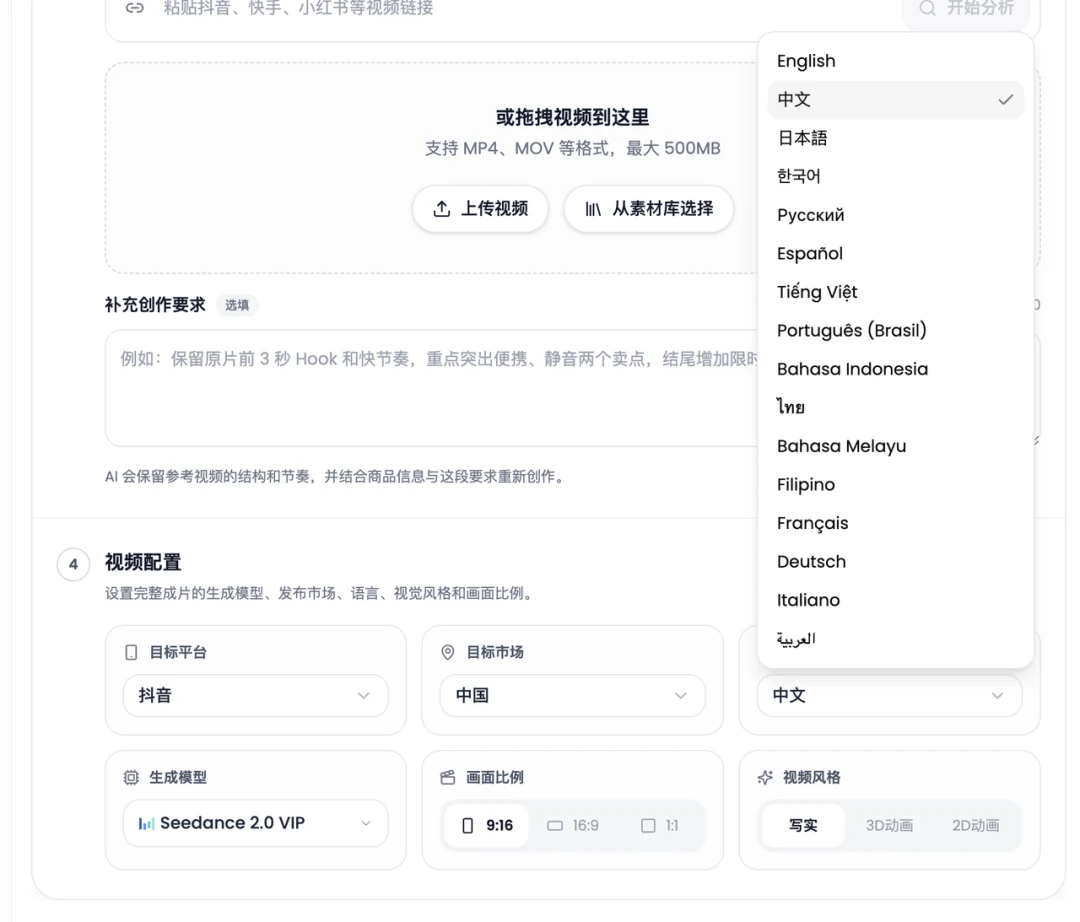
Vibbit language and aspect-ratio settings in the original Chinese interface.
Batch product video remixing: overcoming manual production limits
To address the challenge of many SKUs and high video demand, Vibbit provides a batch product video remixing feature. Users only need to upload product images and selling point copy, and the AI can batch-generate different styles of product promotion videos. This helps transform video production from "custom-made one by one" to "batch production," allowing long-tail products to have basic video materials and improving overall content coverage.

Vibbit batch editing: shot segmentation, structured editing, and creative variations.
Viral Radar and video analysis: informing creative decisions
Vibbit's "Viral Radar" feature allows users to collect high-potential e-commerce ad creatives through a browser extension and sync them to the workspace. At the same time, the "Viral Teardown and Replication" feature can analyze the structure, pacing, and copy of competitor hit videos, and generate videos in a similar style. These features are not meant to encourage direct copying, but rather to help sellers transform the "viral logic" from intuitive experience into analyzable and reusable structures, thereby reducing creative trial-and-error costs and improving the conversion potential of videos.
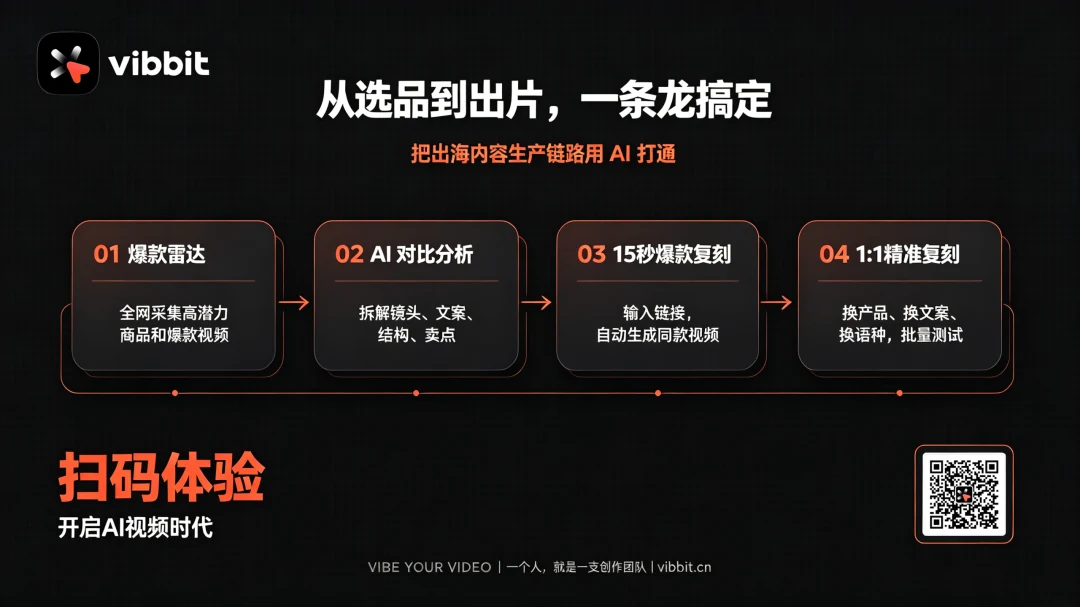
Vibbit e-commerce workflow: product discovery, video analysis, and batch creation.
Automated editing and long-to-short video clipping: improving content utilization
Vibbit's fully automated editing feature can automatically complete operations such as dynamic subtitles, music beat synchronization, opening hooks, and decorative text effects, lowering the editing barrier for non-professionals. At the same time, the long-to-short video clipping feature can automatically cut a livestream or long video into as many as 20 short clips with communication potential. For e-commerce sellers, this means that content from a single livestream or product explanation can be quickly split into multiple short videos for different channels, greatly improving content reuse.
Digital human multilingual voiceovers: unifying brand image and lowering the barrier to on-camera presence
Vibbit supports creating AI digital human avatars and automatically switching between multiple languages for voiceovers. This feature can help sellers avoid the uncertainty of real-life models in terms of time, location, and condition, while maintaining brand image consistency across multilingual scenarios. For sellers who need to frequently produce product introduction videos, digital humans provide a relatively stable and cost-controllable on-camera solution.
Multi-platform aspect ratio adaptation: reducing manual adjustment workload
Different platforms have different requirements for video aspect ratios and formats, and manual adjustment is time-consuming and error-prone. Vibbit supports one-click output of video sizes adapted to TikTok, YouTube, Instagram, and other platforms, reducing post-export processing work and improving the efficiency of multi-platform distribution.
Batch generation and rapid iteration: making testing possible
Vibbit's batch ad creative generation capability can, according to official introduction, produce 100 independent ad creatives at a time. This provides e-commerce sellers with the foundation for A/B testing: they can generate a large number of different video versions in a short time, distribute them across different channels, and quickly eliminate low-performing materials while amplifying high-performing ones based on data feedback. This rapid iteration capability is one of the key means to improve video efficiency.
V. Conclusion: Tools Solve Efficiency Problems, but Creativity Remains the Core
In the second half of e-commerce video content competition, "video efficiency" will become a key metric that separates merchants. However, it should be made clear that AI tools primarily solve production efficiency and production cost problems, not replace creativity itself. Platforms like Vibbit are more like taking repetitive and technical work off the team's hands, allowing the team to focus more energy on product selection strategy, selling point refinement, and user insight.
For e-commerce sellers, whether to adopt AI video tools is essentially a return-on-investment judgment: if the tool can help the team produce more, better-adapted, and more promising video materials in the same amount of time, then video efficiency has the opportunity to achieve overall improvement.