Why Do E-commerce Teams Fall Behind on Video Production? Three Hidden Bottlenecks
Uncover three hidden bottlenecks in e-commerce video production: multilingual adaptation, batch demand, and costly creative testing.
In e-commerce operations, the importance of video content no longer needs to be argued. However, a common confusion persists: the team clearly recognizes the value of video and has invested manpower, budget, and time, so why does video production capacity still fail to keep up with the operational pace?
On the surface, the problem seems to be "not enough people" or "insufficient budget." But upon deeper analysis, it becomes clear that what truly slows down video production capacity is often not the total amount of resources, but three easily overlooked hidden bottlenecks. If these bottlenecks are not addressed, simply adding more people or increasing the budget will yield only limited efficiency gains.
I. Bottleneck One: The Hidden Cost of Multilingual Adaptation Is Seriously Underestimated
For cross-border sellers or e-commerce teams targeting multilingual markets, the first hidden bottleneck in video production capacity is the complexity and cost of multilingual adaptation.
Many teams habitually estimate workload on a "per video" basis when planning video production. But in actual operations, a single product video often needs to cover multiple language markets. If each language version requires separate filming, separate dubbing, and separate lip-sync adjustment, then the actual workload is not "1 video," but "1 video × N languages."
What makes this even more challenging is that multilingual adaptation is not just about translating subtitles. Videos with real people on camera involve differences in lip movements, tone, and cultural expression; dubbing requires finding suitable multilingual voice actors; and the length of text in different languages can affect the pacing of the visuals. If any one of these aspects is handled poorly, video quality suffers, but processing each one individually multiplies costs and time.
The reason this bottleneck is "hidden" is that during the planning stage, teams often only see the production cost of a single video, while overlooking the multiplier effect brought by multilingual versions. It is only during actual execution that they realize production capacity is being heavily consumed by multilingual adaptation.
II. Bottleneck Two: Structural Mismatch Between Bulk Demand and Manual Editing Capacity
The second characteristic of e-commerce videos is high demand volume and high repetitiveness. A store may have dozens or even hundreds of SKUs, each requiring a product video; at the same time, different platforms have different requirements for video dimensions and formats, so the same content often needs to be output in multiple versions.
This "multi-product × multi-platform" demand structure is clearly mismatched with the capacity of manual editing. A skilled editor can only produce a limited number of videos per day. As the number of SKUs increases and the demand for multi-platform distribution grows, manual editing quickly becomes a production capacity bottleneck.
As a result, many teams have no choice but to make trade-offs: prioritize videos for a few best-selling products, leaving long-tail products without video materials for extended periods; or sacrifice video quality to meet quantity demands, leading to content homogeneity and poor conversion performance.
The "hidden" nature of this bottleneck lies in the fact that it is often mistaken for "editors not working hard enough" or "processes not optimized enough." But in essence, this is a structural mismatch: the demand is batch-based and repetitive, while manual editing is one-by-one and linear. If the production method is not changed, simply adding more people will lead to diminishing marginal efficiency gains.
III. Bottleneck Three: The Cost of Creative Trial-and-Error Is Too High, Leading to "Dare Not Try, Cannot Afford to Try"
The third hidden bottleneck is not on the execution side, but on the creative side.
What kind of video is more effective? How should the opening be designed to retain users? What order of selling points is more conducive to conversion? There are no standard answers to these questions; they can only be validated through testing. However, under the traditional video production model, each creative version tested requires new filming, editing, and dubbing, with costs often ranging from hundreds to thousands of yuan, and timelines measured in days.
This puts e-commerce teams in a dilemma: they know they should test more and iterate faster, but in practice they "cannot afford to try." As a result, they can only rely on experience-based judgment or directly imitate competitors. And once the creative direction is misjudged, the upfront production investment is wasted.
What is even more troublesome is that the traffic environment on e-commerce platforms changes rapidly, and the life cycle of hot topics and user preferences is becoming shorter and shorter. If the speed of creative iteration cannot keep up, video content will quickly become "outdated." But rapid iteration means higher trial-and-error costs, which causes many teams to become conservative in creativity, ultimately falling into a vicious cycle of "mediocre content—poor performance—even more reluctant to try."
The reason this bottleneck is "hidden" is that it does not manifest as specific production delays, but rather as an overall low video efficiency. The team is indeed continuously producing videos, but the conversion performance of these videos is unsatisfactory, essentially because of the lack of low-cost trial-and-error capability.
IV. How to Break Through These Three Hidden Bottlenecks?
To break through the above bottlenecks, the key lies not in simply increasing resource input, but in changing the video production method. More specifically, it means handing over highly repetitive, technically demanding, and scalable tasks to AI and automation tools, allowing the team to focus their energy on selling point refinement, creative strategy, and data analysis.
Vibbit, as an AI-driven video creation platform, has functional designs that are in part aimed precisely at these three bottlenecks.
To address the hidden cost of multilingual adaptation, Vibbit provides multilingual video generation capabilities. Users shoot material once, and the system can automatically generate versions in more than 10 languages, including English, Japanese, Korean, and Southeast Asian languages, with natural lip-sync. When applied to e-commerce scenarios, this capability means sellers do not need to film separately for each language or hire multilingual hosts, thereby significantly reducing the production cost and time for multilingual content. At the same time, the digital human multilingual voiceover feature offers an alternative for multilingual scenarios that require a stable on-camera presence.
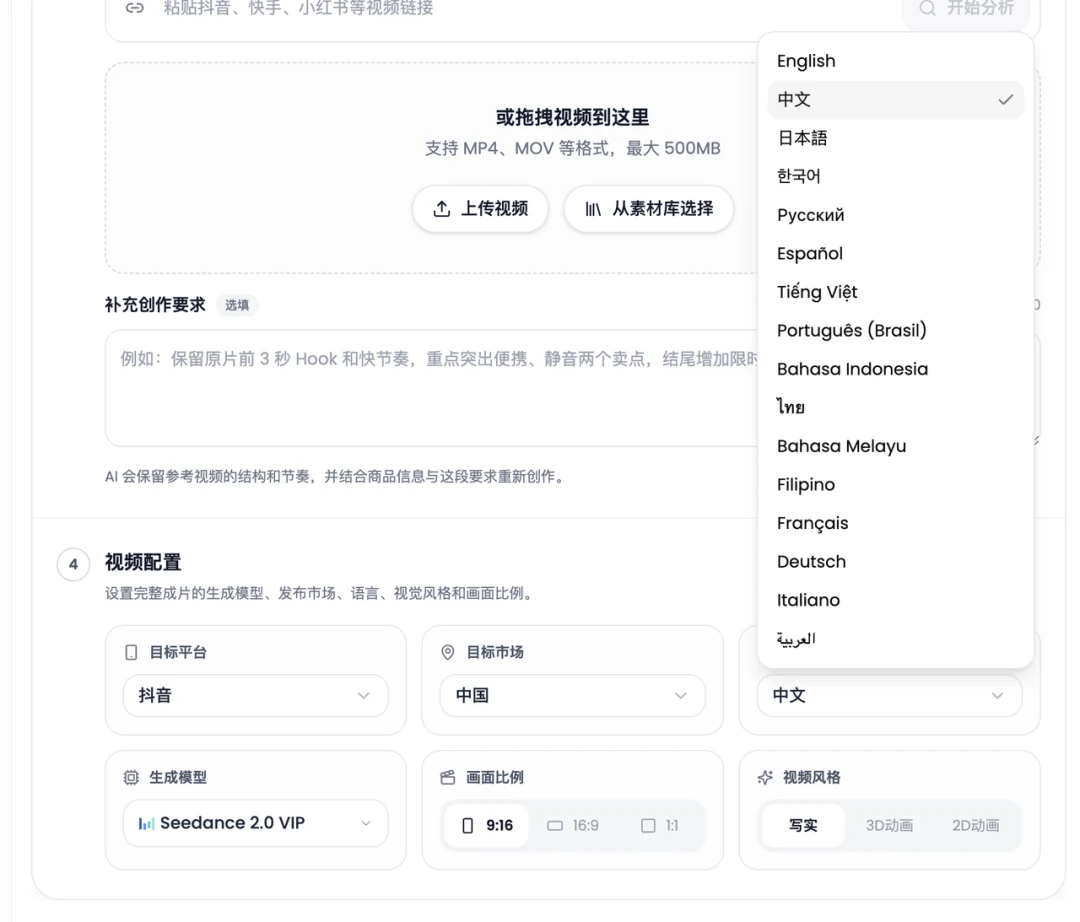
Vibbit language and aspect-ratio settings in the original Chinese interface.
To address the mismatch between bulk demand and manual production capacity, Vibbit provides batch product video remixing and batch ad creative generation. Users upload product images and selling point copy, and the AI can batch-generate different styles of promotional videos; according to official introduction, up to 100 independent ad creatives can be produced at a time. This batch production capability helps transform video production from "custom-made one by one" to "batch production," allowing long-tail products to have basic video materials and alleviating the capacity pressure on manual editing.
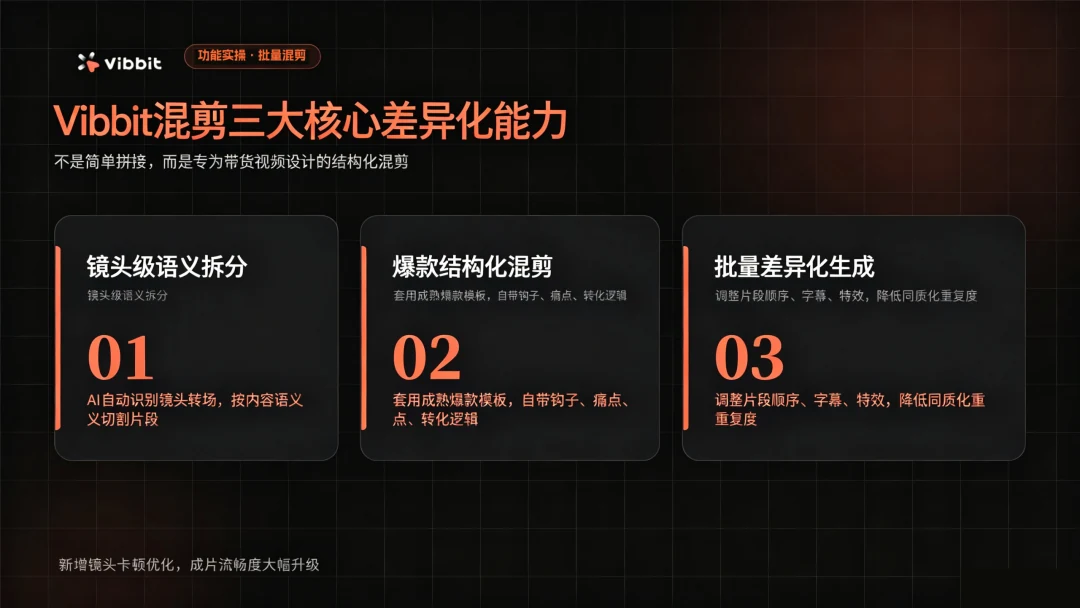
Vibbit batch editing: shot segmentation, structured editing, and creative variations.
To address the issue of high creative trial-and-error costs, Vibbit offers "Viral Radar" and "Viral Teardown and Replication" features. "Viral Radar" allows users to collect high-potential e-commerce ad creatives through a browser extension and sync them to the workspace; "Viral Teardown and Replication" can analyze the structure, pacing, and copy of competitor hit videos and generate videos in a similar style. These features are not meant to encourage direct copying, but rather to help teams transform the "viral logic" from intuitive experience into analyzable and reusable structures, thereby reducing trial-and-error costs. Combined with batch generation capabilities, teams can generate multiple creative versions in a short time for testing and iterate quickly based on data feedback.
In addition, Vibbit's long-to-short video clipping feature can automatically cut a livestream or long video into as many as 20 short video clips, improving content reuse; the multi-platform aspect ratio adaptation feature reduces repetitive adjustment work during multi-platform distribution.
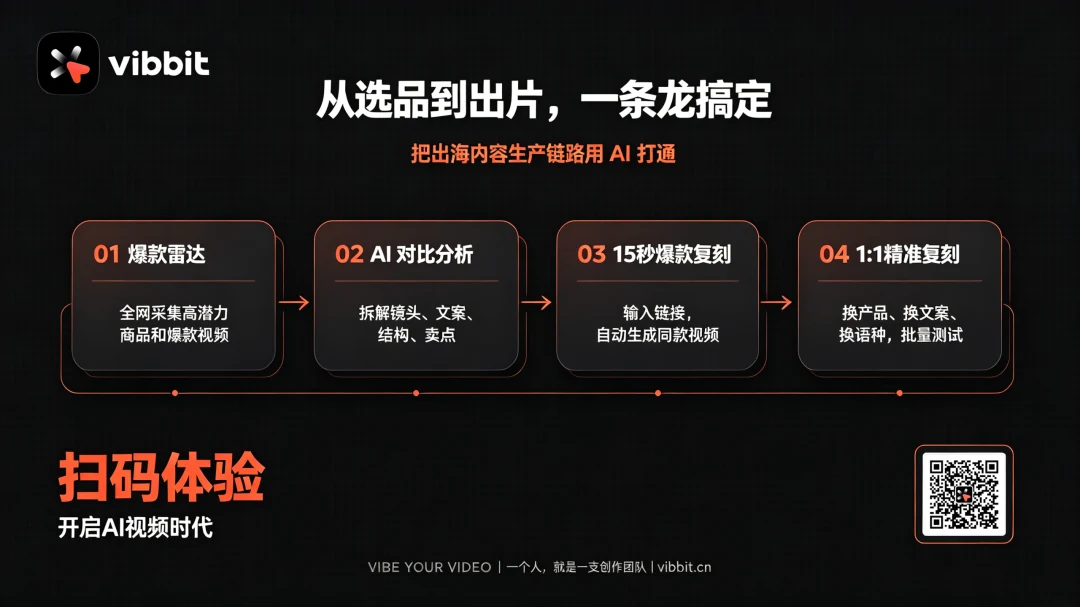
Vibbit e-commerce workflow: product discovery, video analysis, and batch creation.
V. Conclusion: The Essence of the Capacity Problem Is a Production Method Problem
The reason e-commerce teams' video production capacity cannot keep up is often not because the team is not working hard enough, but because there is a mismatch between the production method and content demand. When video demand shifts from "a small number of high-quality pieces" to "batch supply across multiple languages, multiple platforms, and multiple SKUs," the traditional method of relying on manual one-by-one production will inevitably hit a production capacity ceiling.
To break through this ceiling, changes need to be made in production tools and production processes. The value of AI video tools lies not in completely replacing humans, but in automating repetitive and technical tasks, allowing teams to create and experiment at lower cost and faster speed.
Vibbit offers a trial experience, and e-commerce teams can first experience its core features to evaluate the efficiency improvements in their actual workflow. In an increasingly competitive video content landscape, those who can first solve the production capacity bottleneck are more likely to take the lead in the competition for "video efficiency."