From 0 to 1: Building an E-commerce Video Content Production Line — An Operator's Retrospective
An operator reflects on building an e-commerce video production pipeline for multiple SKUs, platforms, and languages with AI and human oversight.
In the e-commerce industry, the importance of video content no longer needs to be argued. The real difficulty is this: when a team moves from a small number of SKUs and a single market to large-scale operations across multiple platforms, multiple languages, and multiple products, how can the video content production method keep up with the pace of business?
Over the past year, my team went through a shift from "having any video is enough" to "we must have a stable video supply capability." This process was not smooth, but it gave me a more concrete understanding of the term "e-commerce video content production line." The following is a stage-by-stage retrospective, recording the detours we took, the adjustments we made, and some judgments that are still being validated.
I. Starting Point: We Once Thought "Not Enough Videos" Was a People Problem
Initially, our video production mainly relied on two methods: outsourcing to external teams, and having one or two internal colleagues do part-time editing. When we had few SKUs and operated in only a single market, this model barely worked. But as the business expanded to multiple platforms and multilingual markets, problems began to erupt in concentrated fashion.
- Outsourcing had long turnaround times and high communication costs, and quotes rose year after year.
- Internal colleagues were not professional editors, so output quality was unstable and efficiency was limited.
- The most painful issue was multilingual versions: every time we added a language market, we had to re-record voiceover, adjust subtitles, or even reshoot, multiplying the workload.
Our first reaction was "we don't have enough people," so we tried hiring more editors. But we quickly found that simply adding people did not bring a qualitative improvement. New hires needed training, quality was uneven, and management costs rose. Video capacity still couldn't keep up with business demand.
Looking back, the fundamental problem at this stage was not the number or ability of people, but that we were using a linear, artisanal-workshop approach to meet a batch-oriented, systematic content demand.
II. Turning Point: Rethinking What "Production Line" Really Means
During an internal review, we realized a key point: the demand structure of e-commerce video is completely different from traditional film and television production.
Traditional film and television is about taking one video from concept to final cut and maximizing the quality of that single piece. But the demand for e-commerce video is:
- Multiple SKUs: every product needs a demo video.
- Multiple platforms: the same content needs to be adapted to different sizes and formats.
- Multiple languages: the same product needs to be delivered to different language markets.
- High-frequency updates: test creatives, campaign assets, and daily content are continuously consumed.
Under this demand structure, if every video is produced as a "project," the capacity ceiling will be very low. What really needs to be built is not "the ability to make more videos," but a sustainable, replicable, and scalable video content production line.
The differences between a production line and an artisanal workshop are:
- An artisanal workshop depends on individual skills, so output is unstable.
- A production line depends on processes and tools, so output is predictable and scalable.
- The capacity ceiling of an artisanal workshop is "people's time"; the capacity ceiling of a production line is "system efficiency."
Once this became clear, we began breaking video production into multiple steps: scripting, asset preparation, editing, subtitles, voiceover, multilingual adaptation, and multi-platform export. Then we analyzed each step: which parts must retain human judgment, and which can be handed over to tools.
III. Building the Process: Handing Automatable Steps to AI
After breaking down the workflow, we found that at least half of the steps are highly repetitive and technical, but require little creative judgment. For example:
- Subtitle generation and timeline alignment
- Switching between multilingual versions and lip-sync adjustment
- Adaptation to different platform dimensions
- Batch generation of videos with similar structures
- Extracting highlight clips from long videos
If these steps rely on manual work, they consume a great deal of time. But if suitable tools can be found, the team can be freed from repetitive labor and focus on product selection, selling-point extraction, and creative strategy.
At this stage, we started exploring and testing Vibbit. It is an AI-powered video creation platform. According to its official introduction, it integrates the complete process from planning, shooting, editing, and voiceover to distribution into one platform, using an AI agent and 57 professional tools to achieve one-stop creation. We tested it with one question in mind: "Can it solve the problems we identified after breaking down the process?"
Multilingual adaptation: from "making each version one by one" to "generating in one pass"
Multilingual content was one of our biggest headaches. In the past, every time we entered a new language market, we had to remake video versions. Vibbit's multilingual video generation feature allows users to shoot material once, and the system automatically generates versions in more than 10 languages with natural lip-sync. After actual testing, we found that for talking-head product introduction videos, this feature really can eliminate a large amount of repetitive work. Although some languages still require manual fine-tuning, overall efficiency improved significantly.
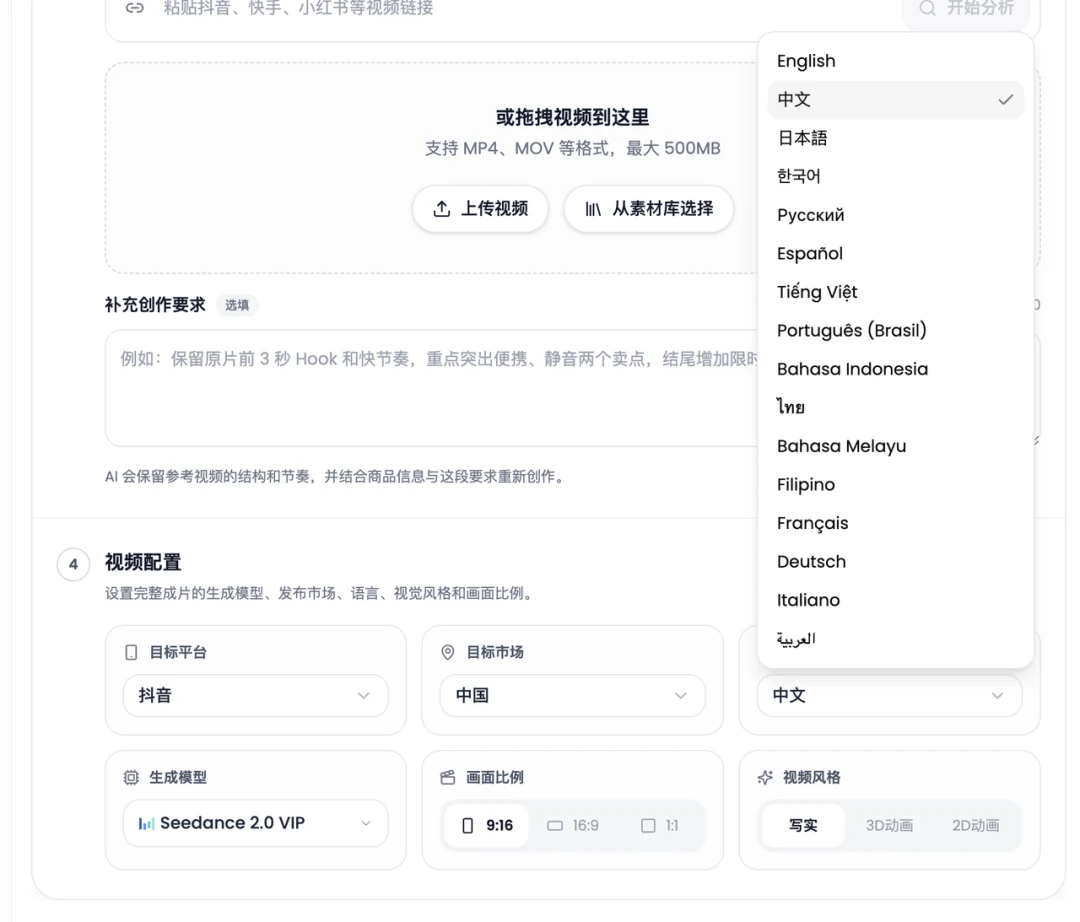
Vibbit language and aspect-ratio settings in the original Chinese interface.
Batch mashup editing: long-tail SKUs can also have videos
In the past, our video resources were concentrated on a few hero products, while long-tail products had no videos for a long time. Vibbit's batch mashup editing feature for product videos allows us to upload product images and selling-point copy, and AI batch-generates different styles of product-promotion videos. Although these videos cannot compare with highly polished videos, they are sufficient to fill the video gap for long-tail products. The official introduction also says batch generation of ad creatives can produce up to 100 independent assets at a time. In our actual test, the number generated was below this upper limit, but it did cover the basic needs of multiple products.
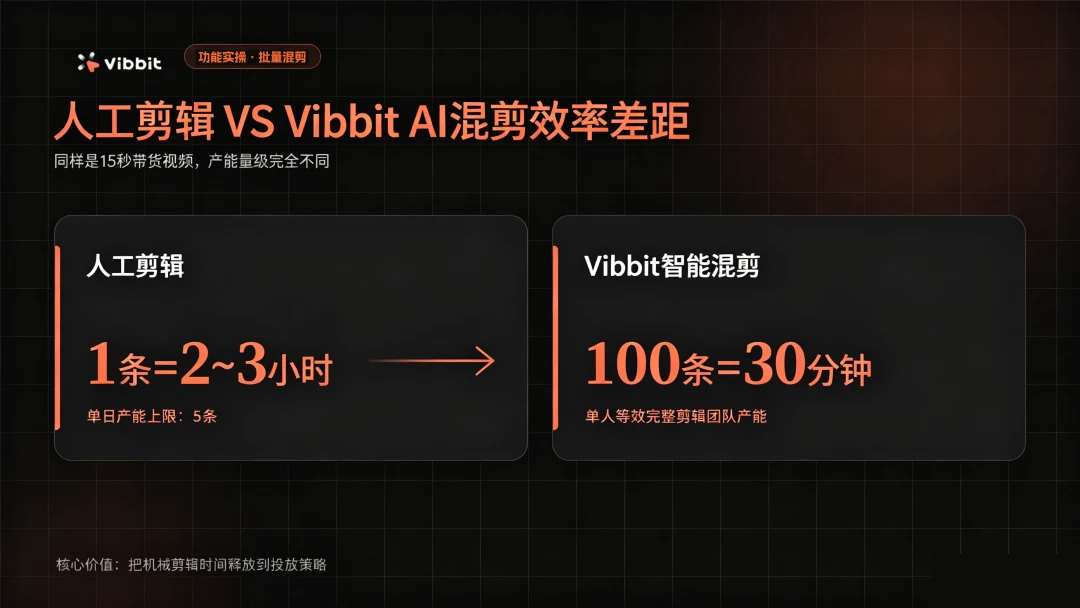
The supplied illustration compares manual editing and the Vibbit batch-editing workflow.
Creative reference: from "relying on gut feeling" to "having a basis"
In the past, we judged whether a video was good mainly by personal feeling. Vibbit's "hit radar" and "hit breakdown and replication" features allow us to collect and analyze high-potential ad creatives from competitors, break down the structure, pacing, and copy of hit videos, and then generate test assets in a similar style combined with our own products. The value of this feature is that it turns creative judgment from subjective experience into a referenceable framework. Of course, we always emphasize that breakdown does not mean copying; it means learning the structure and injecting our own content.
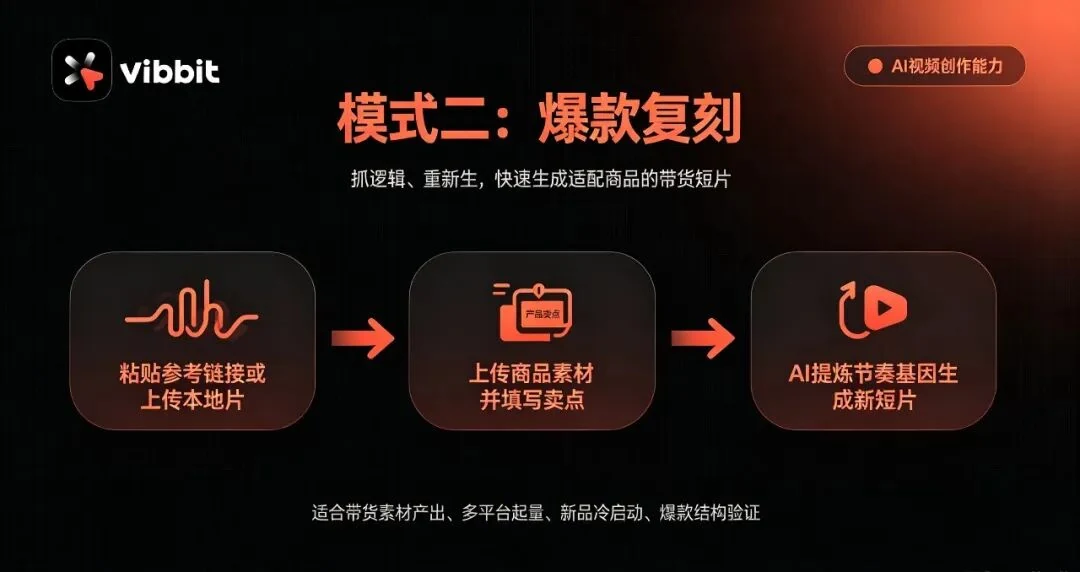
Vibbit workflow for creating product videos from reference structure and product assets.
Content reuse: material from one livestream can become dozens of short videos
We often do livestreams, but the utilization rate of post-livestream material was very low. Vibbit's long-video-to-short-video feature can automatically edit up to 20 short video clips with viral potential from a livestream or long video. This feature helped us turn one round of content production into multiple rounds of distribution, extending the lifecycle of existing assets.
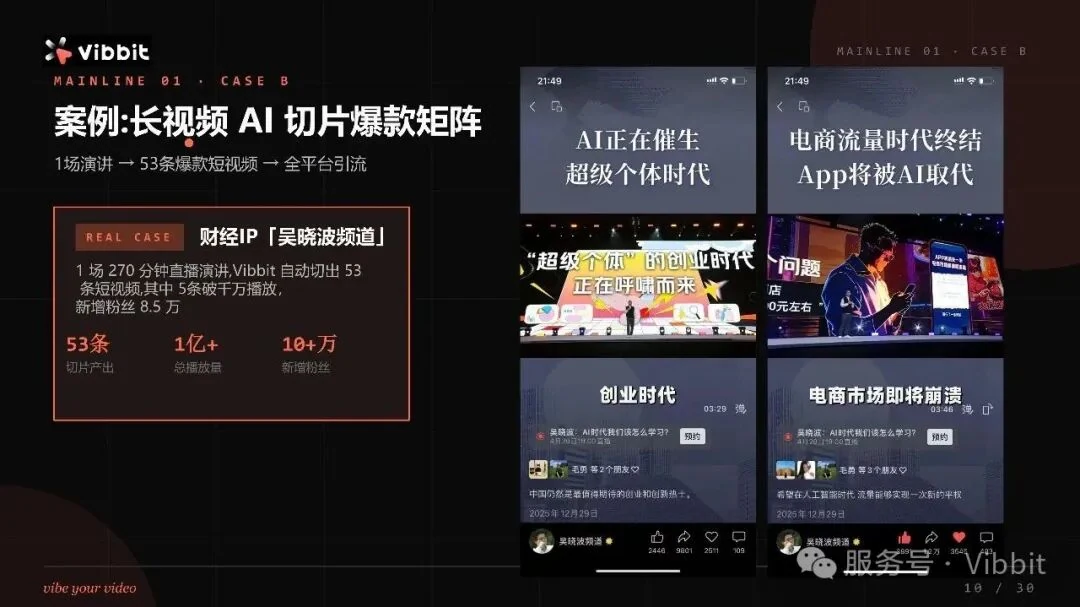
A supplied Vibbit case illustration showing clips repurposed from a long video.
IV. Reflection: Tools cannot replace strategy, but they can amplify its execution
After several months of adjustments, our video capacity improved significantly. But the deepest insight is this: tools themselves are not the answer; the key is whether you are clear about the problem you want to solve.
The real value of AI tools like Vibbit is not "one-click generation of viral videos," but automating the steps that consume manpower without producing core value. It gives the team the conditions to invest more time where human judgment is truly needed: product selection strategy, selling-point extraction, user psychology, data analysis, and creative direction.
V. From 0 to 1 is about building a system, not just adding people
Looking back at this journey from 0 to 1, the biggest change is not that we gained another tool, but that we re-understood the term "video capacity." A lack of capacity is often not a people problem, but a production-method problem.
If you are also building an e-commerce video content production line, my advice is:
First, clarify your video demand structure: multilingual? multiple SKUs? multiple platforms? high-frequency updates?
Break down the production workflow and identify which steps are repetitive and can be standardized.
Evaluate whether tools can cover these steps, rather than blindly pursuing "full automation."
Keep human judgment in the creative and strategy stages, and do not treat tools as a shortcut to replace thinking.
The process of building from 0 to 1 is essentially a redesign of the content production method. If this design is done correctly, video capacity will no longer be the bottleneck.