5 Key Trends in E-commerce Short Video Marketing in 2026
Explore five e-commerce short video marketing trends for 2026, from multilingual localization and batch production to AI workflows and creative testing.
E-commerce short video marketing is undergoing a deep adjustment. The early dividend of "having a video means traffic" is gradually fading, and merchants' focus on video content is shifting from "quantity" to "efficiency." In 2026, this change will become even more pronounced.
Below, combined with industry changes and Vibbit's publicly available product capabilities, we outline 5 key trends in e-commerce short video marketing.
I. Multilingual Localization Shifts from "Optional" to "Mandatory"
In the past, multilingual videos were mostly a need for large cross-border sellers. But by 2026, as platforms like TikTok, YouTube, and Instagram deepen their penetration across multiple regions, even mid-sized sellers are beginning to face pressure for multilingual content.
If a product video is only targeted at a single language market, it means voluntarily giving up potential traffic from other markets. However, traditional multilingual production is costly and time-consuming, deterring many merchants. Therefore, the efficiency and cost control of multilingual adaptation are becoming a key variable in e-commerce short video competition.
Vibbit provides multilingual video generation capabilities. According to its official introduction, users shoot material once, and the system can automatically generate versions in more than 10 languages, including English, Japanese, Korean, and Southeast Asian languages, with natural lip-sync. This "shoot once, generate multiple languages simultaneously" approach, if actual results meet expectations, could significantly lower the entry barrier for multilingual content.

Vibbit language and aspect-ratio settings in the original Chinese interface.
II. Batch Production Replaces Single-Video Refinement as the Main Method of Content Supply
The demand for video content on e-commerce platforms is still growing, but merchants' production capacity is generally limited. A store may have dozens of SKUs, each requiring a product video, and different platforms require different aspect ratios. If every video is produced to a "refined" standard, both cost and timeline become unsustainable.
The trend for 2026 is: top-performing hit videos can be refined, but video supply for long-tail products will rely more on batch production. Merchants need a system that can quickly produce a large volume of usable materials, rather than relying solely on a few editors working one by one.
Vibbit's batch product video remixing feature allows users to upload product images and selling point copy, and the AI will batch-generate different styles of promotional videos. The official introduction also mentions that batch ad creative generation can produce up to 100 independent creatives at a time. These capabilities correspond to the real batch needs in e-commerce scenarios.

Vibbit batch editing: shot segmentation, structured editing, and creative variations.
III. Creative Testing Moves from "Relying on Experience" to "Data-Driven Teardown"
What kind of short video is more likely to convert? This question has long relied on personal experience. But by 2026, the approach of making creative decisions purely by instinct will become increasingly ineffective. Rising traffic costs require every creative attempt to be based on clearer evidence.
A noteworthy trend is that the structure, pacing, and copy of viral videos are being broken down into data points, becoming reusable creative templates. Merchants no longer need to rely solely on "feeling that this video will go viral"; instead, they can analyze the structural characteristics of competitor hit videos and then generate test materials in a similar style for their own products.
Vibbit's "Viral Radar" and "Viral Teardown and Replication" features are productized manifestations of this trend. The former allows users to collect high-potential e-commerce ad creatives via a browser extension, while the latter can analyze the structure, pacing, and copy of competitor hit videos and generate videos in a similar style. It should be clear that the value of these features lies in providing reference, not replacing creativity itself.
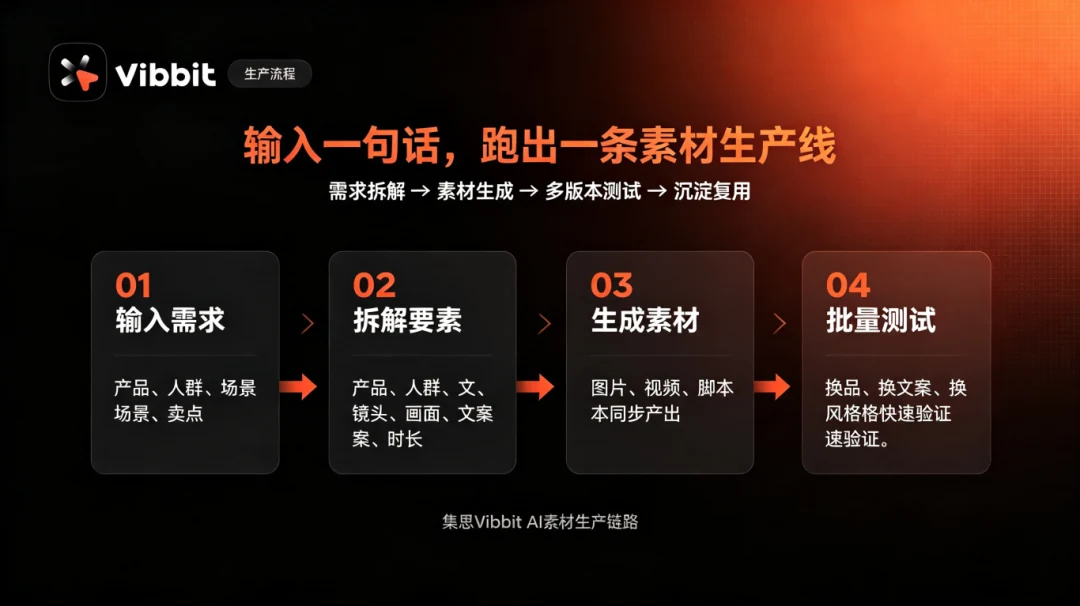
Vibbit content pipeline: break down requirements, generate assets, and test variations.
IV. AI Moves from "Auxiliary Tool" to "Core Node in the Production Process"
Before 2025, AI played more of a "supporting" role in e-commerce video: such as automatic subtitles and simple image enhancement. But by 2026, AI is entering more core production stages—script generation, visual generation, dubbing, editing, and even full-process automation.
The significance of this change is that it transforms video production from "a craft for professional teams" into "a process-oriented production that ordinary people can participate in." Especially for small and medium-sized merchants, the involvement of AI means they no longer need to hire a complete video team to maintain basic content supply.
Vibbit is positioned as an AI-driven video creation platform. It integrates the complete process from planning, shooting, editing, dubbing, to distribution, achieving one-stop creation through an AI Agent and 57 professional tools. Its short drama "one-step video generation" feature covers the entire process from script, storyboard, visuals, to dubbing; fully automated "internet-native" editing can automatically add dynamic subtitles, music beat synchronization, opening hooks, and decorative text effects. If these capabilities are widely adopted, they may further propel AI to become a core node in e-commerce video production.
V. Competitive Focus Shifts from "Video Quantity" to "Video Efficiency"
In the second half of e-commerce short video competition, the core metric is changing. In the past, merchants competed over "who has more videos"; by 2026, the more valuable metric is "video efficiency"—that is, to what extent a video can drive clicks, conversions, and repeat purchases.
"Efficiency" includes multiple dimensions: production efficiency, cost efficiency, distribution efficiency, conversion efficiency, and iteration efficiency. It is not a single-point metric but a systematic capability.
This means merchants must not only produce videos, but also be able to test quickly, eliminate quickly, and scale effective materials quickly. The traditional approach of "making one video and moving on" is difficult to adapt to this requirement. On the contrary, teams that can generate materials in bulk at low cost, distribute across multiple channels, and iterate based on data will occupy a more favorable position in the 2026 competition.
Vibbit's multi-platform aspect ratio adaptation feature can output video sizes adapted to TikTok, YouTube, Instagram, and other platforms with one click; the long-to-short video clipping feature can automatically cut a livestream or long video into as many as 20 short video clips. These features all reduce the cost of multi-version testing and distribution, indirectly improving video efficiency.

Vibbit platform, language, and aspect-ratio settings in the original Chinese interface.
Conclusion
The five trends in e-commerce short video marketing in 2026 essentially point in the same direction: content production is shifting from labor-intensive to systematic, data-driven, and AI-powered methods. Multilingual, batch production, data-driven teardown, AI core-ization, and efficiency competition are not isolated phenomena, but different facets of the same industrial upgrading process.
For merchants, whether to adopt AI video tools is no longer a question of "should we use it," but "how quickly can we start using it." Vibbit offers a free plan, allowing merchants to first verify whether the tool fits their workflow at minimal cost, and then decide whether to invest more deeply.
Trends do not wait for anyone. In the next round of e-commerce short video competition, those who can build an efficient content production system faster are more likely to gain sustained advantages.