The Real Reason Your Product Video Conversion Rate Is Low May Not Be Shooting but Editing
Learn how hooks, selling-point order, subtitles, pacing, and platform adaptation can affect product video conversions before you reshoot.
In e-commerce operations, a common frustration is this: the product images and selling points are good, the video has been shot, yet the product video's conversion rate remains consistently unsatisfactory. Many teams' first reaction is that "the shooting isn't good enough," so they invest more budget in upgrading equipment, changing scenes, and reshooting footage. But the results often fall short of expectations.
The problem may not lie in the shooting stage, but in editing.
Shooting determines the raw material quality of a video, but editing determines the video's information delivery efficiency and conversion capability. For product videos aimed at conversion, the details handled in the editing stage often affect user viewing behavior and purchase decisions more directly than shooting image quality. This article attempts to break down several key issues in product video editing that are easily overlooked, and to explore possible optimization directions by referencing Vibbit's public features.
I. Why Might the Problem Be in Editing?
The relationship between shooting and editing is similar to that between raw materials and processing technology. Good raw materials are the foundation, but if the processing stage is rough, even the best footage cannot be turned into effective sales content.
A product video is different from a brand promotional film. Its core purpose is to clearly convey selling points within a short time and push users to complete the conversion action. Users will not stay because the visuals are beautiful, but they will watch to the end and develop purchase intent because the information is clear, the pace is comfortable, and the key points are prominent.
The shooting material of many product videos is itself qualified, or even quite good, but the following problems occur in the editing stage:
- The first few seconds fail to hook users, causing massive drop-off.
- The order of selling points is confusing, and users finish watching without knowing what the product's core advantage is.
- Subtitles are missing or out of sync, making information delivery fail in muted scenarios.
- The video dimensions are not adapted to the platform, causing images to be cropped or leaving too much blank space.
- The pacing is sluggish, and users lose patience midway.
None of these problems are related to shooting image quality; they are directly determined by editing decisions. Therefore, when product video conversion rates are low, re-examining the editing stage may be more effective than blindly reshooting.
II. Four Common "Invisible Killers" in Product Video Editing
Lack of an effective hook at the beginning
The first 3 seconds of a product video determine whether users keep watching or swipe away. Many videos use a brand logo or scene setup at the beginning, but users do not care about the brand; they care about "what this thing can do for me." If editing does not move the core selling point or the most attractive visual to the front, users are likely to drop off before the information even reaches them.
Vibbit's fully automated "internet-savvy" editing feature, according to its official introduction, can automatically handle the operation of designing an opening hook. This means the editing process can incorporate the "opening hook" as a standard module rather than relying on the experience and intuition of the editor. Of course, the content of the hook still needs to be designed in combination with product selling points; the tool provides structural and efficiency support.
Unreasonable information density and order of selling points
The duration of a product video is limited, usually only a dozen or so seconds to a few dozen seconds. Within this limited time, the selection and ordering of selling points directly affect the effectiveness of information delivery. If there are too many selling points, users cannot remember them; if the order is chaotic, the core advantage gets buried; if the information density is too low, users find the content hollow.
The essence of editing is the selection and ordering of information. But when many product videos are edited, the footage is simply stitched together along the timeline, lacking active design of the selling-point logic. Vibbit's "hit breakdown and replication" feature can analyze the structure, pacing, and copy of competitors' viral videos, helping teams understand how a high-converting video organizes information and providing a reference framework for their own editing. This kind of reference is not copying; it is turning the "viral logic" from intuitive experience into an analyzable structure.
Mismatch between subtitles and pacing
On mobile and social platforms, a large number of users are accustomed to watching on mute. Subtitles become the core carrier for conveying information. If subtitles are missing, out of sync, or poorly formatted, the video's conversion performance will be greatly reduced. In addition, the rhythm at which subtitles appear, and their coordination with the visuals and music, also directly affect the viewing experience.
Vibbit supports automatic subtitle generation and can automatically match the timeline. This solves the most time-consuming part of subtitle production—timeline alignment. For product videos that require multilingual subtitles, Vibbit also supports subtitle translation and can automatically generate multilingual versions. This provides a basic condition for distributing product videos in multilingual markets and reduces the repetitive labor of manually creating subtitles.
Platform adaptation and size adjustment are overlooked
The same product video has different requirements for dimensions and formats on platforms such as TikTok, YouTube, and Instagram. If editing does not adapt to the platform, the video may suffer from image cropping, key information being blocked, or incorrect aspect ratios, directly affecting viewing experience and conversion rate. However, manually adjusting sizes for each platform is repetitive and time-consuming work.
Vibbit provides a multi-platform size adaptation feature that can output video dimensions suitable for TikTok (vertical), YouTube (horizontal), Instagram (square), and other platforms in one click. This essentially turns "platform adaptation" from a tedious post-editing operation into a standardized, batch-completable step, lowering the operational threshold for multi-platform distribution.
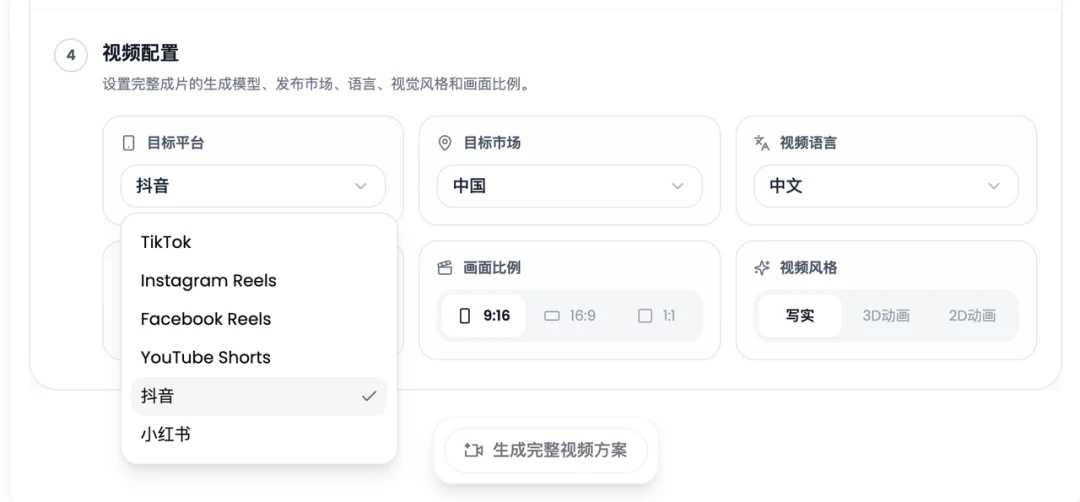
Vibbit platform, language, and aspect-ratio settings in the original Chinese interface.
III. The "Production Efficiency" of the Editing Stage Also Affects Conversion Rate
In addition to the editing quality of individual videos, the production efficiency of the editing stage also indirectly affects conversion rate. The reason is that optimization of e-commerce videos often relies on multi-version testing.
If a team takes several days to produce one test version, the creative directions it can test are very limited, making it hard to find a truly high-performing video structure. Conversely, if the team can quickly produce multiple editing versions for A/B testing, it has more opportunities to discover high-conversion combinations.
Vibbit's batch mashup editing feature for product videos allows users to upload product images and selling-point copy, after which AI batch-generates different styles of product-promotion videos. The batch generation feature for ad creatives can produce up to 100 independent assets at a time. This batch capability provides a foundation for multi-version testing. Teams can generate multiple editing versions in a relatively short time, put them into testing, and iterate based on data feedback, gradually approaching the optimal editing plan.
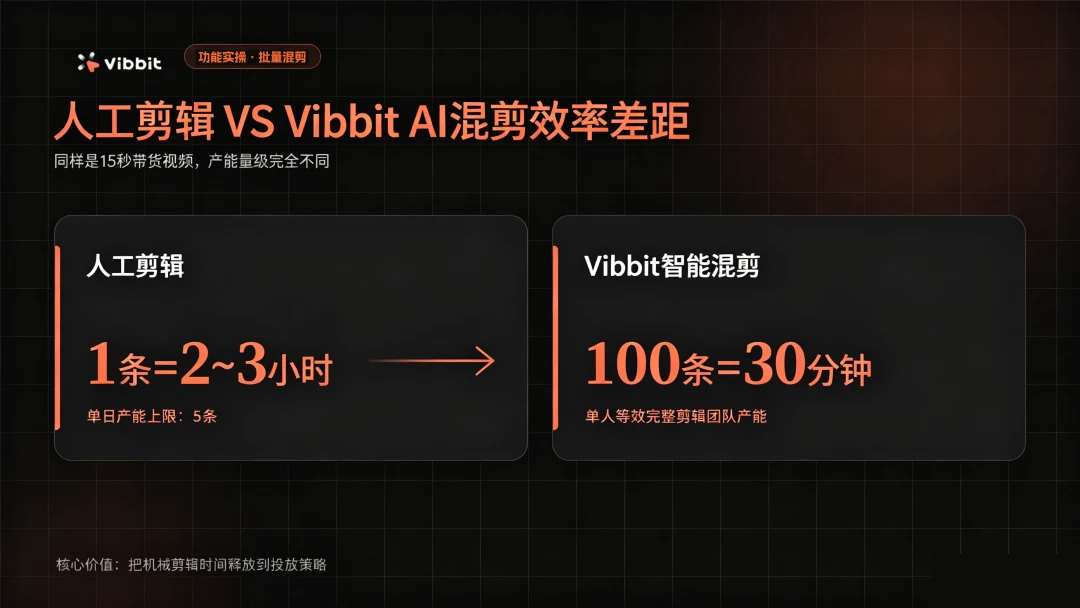
The supplied illustration compares manual editing and the Vibbit batch-editing workflow.
IV. Re-examining Editing May Be the Leverage Point for Improving Conversion Rate
A low product video conversion rate is the result of multiple factors working together, and it cannot simply be attributed to a single stage. However, as the "last mile" connecting footage to users, the impact of editing is often underestimated. If the shooting material already has basic quality, but the video's completion rate, click-through rate, or conversion rate is still low, then the problem most likely lies in the information organization, pacing control, and detail handling of the editing stage.
Vibbit's public features cover several key stages in product video editing: opening hook design, automatic subtitles, multi-platform adaptation, batch generation, viral structure reference, and more. The value of these features is not only in improving the editing efficiency of individual videos, but more importantly in helping teams build an editing process that is testable, iterable, and scalable.
For e-commerce teams, when conversion rates are unsatisfactory, it may be better to pause the idea of reshooting and instead go back and break down the editing details of existing videos: Did the first 3 seconds retain users? Are the selling points clear and well-ordered? Do subtitles cover muted scenarios? Is platform adaptation in place? These editing-level optimizations often cost less than reshooting, but their impact on conversion rate may be more direct.