Batch-Generating E-commerce Ad Video: A Full Breakdown of the Vibbit Remix Workflow
What breaks people when making e-commerce ad video is not a shortage of material.
What breaks people when making e-commerce ad video is not a shortage of material. It is having a mountain of material and still not producing more than a couple of pieces that actually perform. A lot of people assume batch generation means finding a template, dropping product photos into it and adding music. Then it runs, the click-through rate comes in under 1%, and the money burns faster than water.
E-commerce ad video that reliably drives orders is not assembled. It is remixed and rebuilt. Behind it sits a complete workflow running from decomposing material to assembling scripts, deriving variants in bulk and filtering by data. Here is that whole process, worked through with Vibbit's remix capability.
The core of batch-generating e-commerce ads is not piling up volume but structured remixing plus data-driven filtering. The tool turns material into combinable building blocks; you judge which block will move a customer to pay. Volume is only the result — precision is the precondition.
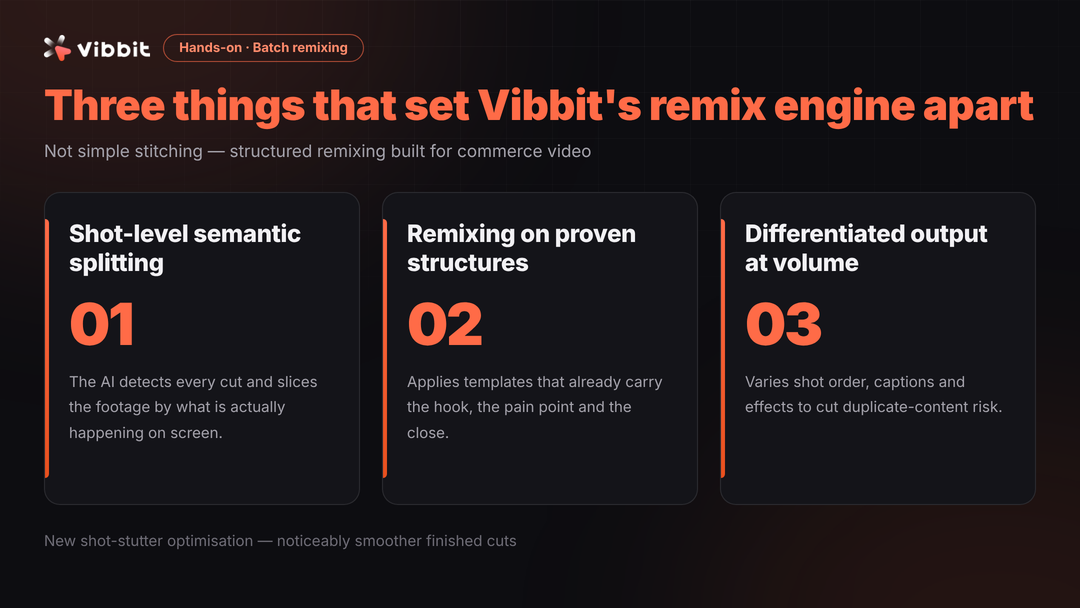
I. Decompose the selling points and build a searchable asset library: smart tagging in Vibbit
Most sellers get the first step of remixing wrong: they open the editing software, drag the footage in and splice it at random. Twenty videos later, every one looks the same, and the whole lot dies on delivery.
The right approach is to let the tool dismember your raw material into callable fragments and tag them first.
Import your product footage, customer-shot content, talking-head explainers and scene demonstrations into Vibbit, and it completes:
Shot recognition: separating product close-ups, usage sequences, before-and-after comparisons and packaging shots.
Speech transcription and selling-point extraction: identifying the core selling points mentioned in the voiceover automatically — "waterproof," "10-hour battery," "zero sugar, zero fat."
Emotion and scene marking: judging whether a shot carries trust, urgency, pleasure or a pain point.
Automatic tagging: every segment labelled as opening-hook material, selling-point material, trust-proof material, call-to-action material and so on.
This step turns a pile of disordered raw material into a material supermarket. To make a particular kind of video you take ingredients straight off the right shelf, instead of going through every file each time.
The point: remixing depends on material being callable fast. An untagged asset library is a warehouse, not an ammunition depot.
II. Remixing is not random cutting: assembling the script structure from a Vibbit template
E-commerce ad short video has a thoroughly proven structure. An ad that converts rarely escapes this frame:
3-second opening hook → pain point or scene setup → product selling points → trust proof (reviews, certification, data) → call to action (offer, time limit, tap).
Many people get poor results because their structure is muddled: 30 seconds of product specifications up front and the pain point only at the end, by which time the viewer is long gone.
Vibbit's remix workflow does not have you dragging material by hand. You pick the template first, and the tool fills the material in.
In practice:
Choose an e-commerce remix template in Vibbit — pain-point, comparison, review or promotion.
The template generates the shot-list structure automatically, making clear what type of material each shot needs.
Drag the matching segments in from the asset library you tagged in step one, and Vibbit matches pacing and transitions automatically.
If you need voiceover, Vibbit generates the script from the selling points and matches it to the picture.
Pick the pain-point template, for example, and the structure is: pain-point scene (3s) → product appears (2s) → the fix in progress (5s) → before and after (4s) → offer prompt (3s). You place each type of material and the tool aligns the pacing.
The point: remixing is essentially applying a structure. The template keeps the skeleton from falling apart; the material fills in the flesh. You are not editing a video, you are assembling one.
III. Batch generation and differentiation: one piece of material splitting into 100 versions
The most expensive part of e-commerce advertising is testing material. For one product you may need to test dozens of different openings, captions and music tracks before finding the combination that performs. Cutting them one at a time cannot keep pace with the media schedule.
Vibbit's batch remix solves the several-meals-from-one-fish problem:
Batch-replace openings: swap 10 different three-second hooks into the same selling-point video and see which gets the clicks.
Batch-generate caption styles: the same content with three caption treatments — price-led, result-led, deadline-led.
Automatic music matching: three BGM moods — tension, ease, urgency — against the same footage by emotion tag.
Automatic multi-size adaptation: one piece of material output as 9:16 vertical, 1:1 square and 16:9 landscape for different channels.
More importantly, Vibbit supports variable combination. With 5 opening hooks, 4 selling-point segments and 3 closing lines, it generates all 5 × 4 × 3 = 60 videos automatically. Each comes with its own cover, title and caption file, exported straight to the ad platform.
This is no longer editing. It is production. Your role moves from machine operator to strategist — you decide which variables are worth testing and hand the rest to the tool.
The point: the real value of batch generation is not quantity but giving every variable a chance to be tested against data. Batch without differentiation is the same bad video posted 100 times.
IV. Filtering winners with data feedback: letting Vibbit's dashboard retire weak material
The 100 remixed videos you run will perform unevenly. Some may hit 8% click-through and 3% conversion; others 1% and 0.5%. If every round means pulling data from the back end by hand and comparing it in Excel, testing material is still slow.
The last step of Vibbit's remix workflow is automatic data feedback and material marking:
Three-second completion rate, click-through, cost per conversion and ROI are collected for each video automatically and charted for comparison.
High-performing tags are identified: when several videos perform, Vibbit works backwards to the material segments and structure types they share and marks that material as validated.
Weak combinations are retired automatically: combinations whose opening hook falls below the completion threshold are flagged, and weighted down or dropped in the next generation.
Winning templates accumulate: structural combinations that perform repeatedly are saved as your own templates, ready to apply to the next product.
Your asset library gets smarter the more you use it. If round one shows a price-anchor opening beating a pain-point opening by 30% on click-through, round two defaults towards the former. Data is not read and forgotten; it feeds straight back into the next round of production.
The point: winners are not cut, they are filtered. The end of a remix workflow is letting data retire the weak and amplify the strong for you.
The tool handles volume; you handle judgement
Vibbit will tag automatically, apply templates, generate in bulk and feed data back. What it cannot answer for you is the one question that matters most: why should a customer buy from you rather than from someone else?
So the central idea of this workflow comes down to one line:
Batch-generating e-commerce ad video is not using technology to pile up quantity. It is using structured remixing to turn uncertain creative into testable variables, then using data to filter out the combinations that genuinely move people. The tool raises production efficiency tenfold, but what actually makes a customer pay is your understanding of the product's selling points and your read on buying psychology.
Volume is only the method; conversion is the purpose. With the right workflow and a tool like Vibbit, you go from grinding out three videos a day to testing 100 a day — and reliably finding the one that performs.