From Script to Finished Episode: How Short Drama Teams Build a Standardised Batch Editing Pipeline with Vibbit
The short drama industry has reached the stage where throughput decides the winner.
The short drama industry has reached the stage where throughput decides the winner. A mature team may need to deliver a dozen or several dozen finished episodes a week while running multiple projects at once. At that pace, the workshop model that depends on an individual editor's craft cannot hold — throughput is unstable, style drifts, and a single person leaving sends efficiency off a cliff. The real answer is to standardise every stage from script to finished episode, replacing individual experience with tools and process. Vibbit provides exactly that infrastructure: it lets a short drama team build a replicable, scalable, measurable batch editing pipeline. This article breaks down the whole flow — script decomposition, asset management, rough cut, fine cut and multi-version output — and how a short drama team uses Vibbit to standardise production.
I. The core contradiction: throughput demand versus a workshop production model
Short drama's business model requires both speed and volume. A series is often shot and broadcast at the same time, with later content adjusted quickly against performance data, which demands extremely fast response from post-production. In a traditional editing flow, however, one editor carries one episode end to end — reviewing material, rough cut, fine cut, captions, output — which can take a day or two per episode. To expand throughput, the only option is to keep adding people, but good editors are scarce and expensive, and the more people there are, the more complex collaboration becomes and the harder consistent quality is to guarantee.
The root of that contradiction is this: a great deal of the work in short drama editing is standardisable repetitive labour, but in the workshop model it stays bound to individual experience and never becomes systematic capability. Vibbit's role is to move those standardisable stages from depending on people to depending on a system, so a team's throughput is no longer capped by individual efficiency.
II. Step one: decompose the script and turn continuity data into structured data
The starting point of a standardised flow is not editing but the script. Many teams miss one fact: the script itself contains most of the structured information post-production needs — episode, scene, character, dialogue, emotion, setting. Digitise that before the shoot and editing efficiency rises several times over.
Vibbit supports decomposing a script into a structured data table with these core fields:
Episode / scene: corresponding one to one with the material markers.
Character and dialogue: each line mapped to a character, which supports speech recognition and caption generation later.
Emotion tags: conflict, reconciliation, eruption, restraint — the basis for rough-cut pacing and music matching.
Shot size cues: key shots noted in the script ("close-up: female lead in tears") convert directly into material filter conditions.
Pacing notes: which passages need fast cutting and which need space, marked at the script stage.
That data table runs through the entire production flow: on set it is the continuity reference, in editing it is the filter condition, in assembly it is the source of captions and data fields. Vibbit's data table feature turns the script from a text document into a production instruction.
III. Step two: get footage into the library and build the tag system
Asset management is the second key node in a standardised flow. Many teams only discover at the editing stage that their material is chaotic and shots cannot be found, and the root cause is a lack of structured labelling during the shoot.
In Vibbit, the team can tag material as it enters the library, following the scene structure of the script data table. The operating logic:
After the shoot, material is imported into the Vibbit asset library in bulk by scene.
The system inherits episode, character and setting information from the script data table automatically as base tags.
An assistant editor adds shot attribute tags: camera (A/B/C), shot size (extreme wide / wide / medium / close / extreme close-up), movement (locked off / push-pull / tracking), usage status (usable / NG / backup).
Speech recognition generates a time-coded transcript for material with dialogue, so every line becomes a searchable tag.
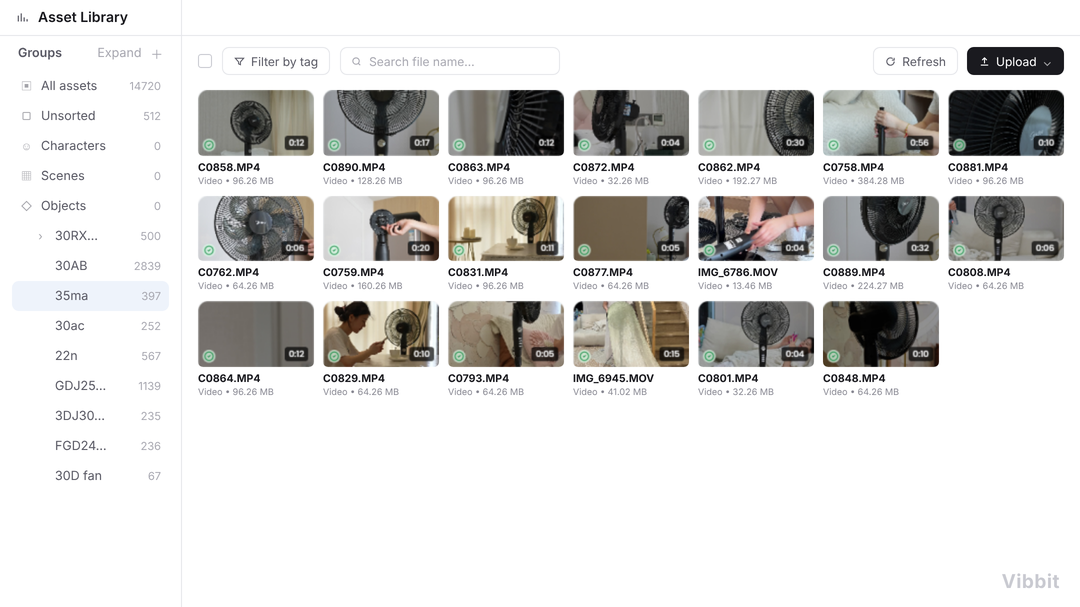
With this step complete, the asset library is a queryable material database. Editors no longer dig through folders or hunt for shots from memory; they locate material in seconds through combined conditions, like using a search engine.
IV. Step three: rule-driven batch rough cutting
The rough cut is the longest stage in the editing flow and also the easiest to standardise. Vibbit's batch rough cut upgrades a team from manual clip-by-clip cutting to automatic rule-driven processing.
Teams can preset rough-cut rules by series type:
Removal rules: automatically delete segments with more than 2 seconds of silence, fragments under 0.5 seconds and shots tagged NG.
Retention rules: keep 0.3–0.5 seconds of breathing room either side of each line, and longer pauses in emotional climax passages.
Filter rules: use only material with "usable" status, with shot-size priority following the script notes (certain passages preferring close and extreme close-up, for instance).
Multi-camera selection: align multi-camera material by timecode or audio waveform and prefer the angle that is sharpest and best framed.
Vibbit generates a rough-cut timeline to those rules, with every segment arranged in script order. What the editor receives is no longer dozens of hours of raw material but a semi-finished piece already filtered. The human work is adjusting pacing on top of that, strengthening the emotion and handling the transitions.
V. Step four: templated fine cutting and automatic assembly
After the rough cut comes the fine cut. This stage still contains plenty of standardisable operations: opener and end card, transition style, caption style, background music, colour presets. Vibbit's template engine manages all of them in one place.
Teams can build fine-cut templates per series type:
Opener template: a consistent brand appearance or series title treatment at a fixed duration, 3 seconds for example.
Transition presets: different transitions matched to the emotional pacing (hard cut, dissolve, flash), with the rules preset in the template.
Caption styles: typeface, size, position and outline defined consistently for dialogue, narration and emphasis captions.
Background music: a music library preset by emotional section, matched automatically or switched by the editor with one click.
Colour presets: a consistent filter and colour style so the whole series stays visually coherent.
Once configured, Vibbit drops the rough-cut timeline into the template automatically and completes transitions, caption generation, audio balancing and grading. The fine-cut editor only makes small adjustments at the key moments instead of rebuilding each episode's structure from scratch.
VI. Step five: multi-version output and distribution
A finished short drama episode often has to go out in several versions at once: 9:16 vertical for Douyin and TikTok, 16:9 landscape for YouTube, 1:1 square for feeds. Platforms differ in caption position, cover size and file size requirements, and adjusting by hand is slow and error-prone.
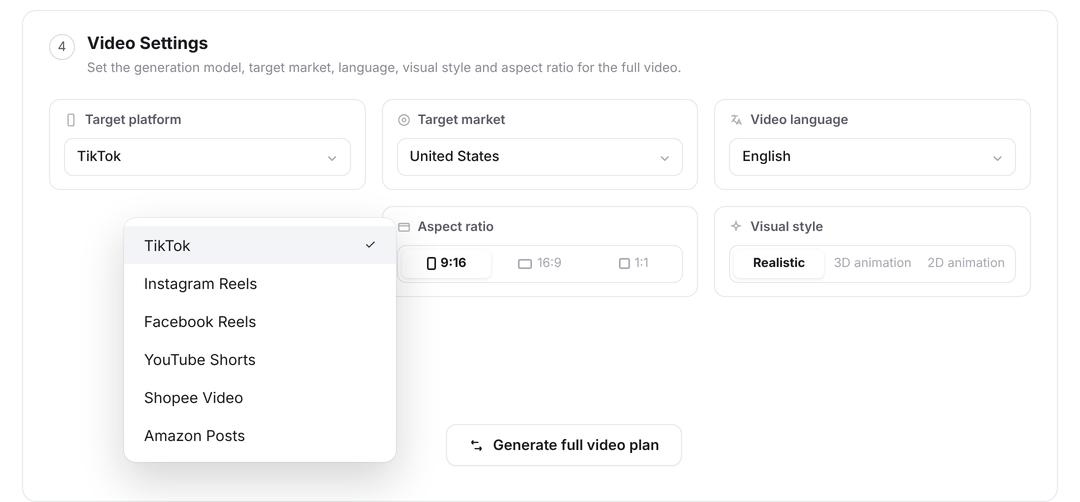
Vibbit's standardisation pays off again at the output stage:
Automatic multi-ratio adaptation: intelligent framing keeps the human subject uncropped and key information intact.
Automatic caption safe-area adjustment: caption position preset per platform so nothing is covered by UI.
Batch cover generation: high-quality frames extracted automatically, the cover template applied, output at the size each platform needs.
File naming conventions: automatic naming by "episode_platform_ratio_language" with a matching distribution list generated.
One render produces every version at once, and the team uploads and distributes straight down the list.
VII. A standardised pipeline is the watershed in short drama throughput competition
Competition in short drama is shifting from who has the hit idea to who has stable throughput. Ideas can come from chance; throughput can only come from a system. The standardised batch editing pipeline Vibbit helps a short drama team build does one thing at heart: it settles the replicable parts of production as system capability and leaves the irreplicable parts to human creativity.
From script decomposition to asset management, from batch rough cut to template assembly, from multi-version output to distribution, standardising each step reduces dependence on individual experience and raises the predictability and stability of overall throughput. Once a team has built such a pipeline, its throughput ceiling is no longer determined by the number of editors but by the processing capacity of the system.
In the industrial era of short drama, the real competitive moat is not any single hit but a production line that turns scripts into finished episodes continuously, stably and efficiently. Vibbit upgrades a short drama team from depending on people to depending on a system, using a standardised process to lever exponential growth in throughput.