Industrialised Short Drama Editing: A Hands-on Test of Vibbit's Batch Rough Cut and Auto-Assembly
The short drama industry has entered industrial production.
The short drama industry has entered industrial production. A 60-episode series of 1–2 minute episodes often generates dozens or even hundreds of hours of raw footage, across an enormous number of scenes, camera angles and dialogue takes. If editors still have to review, cut and splice all of it by hand, post-production can take longer than the shoot itself and costs stay stubbornly high. Vibbit's batch rough cut and auto-assembly features are built for that bottleneck. This article is based on an actual test and breaks down how Vibbit really performs in an industrialised short drama workflow — how it operates and where the efficiency comes from.
I. The industrial bottleneck: not a shortage of creativity, but too much repetition
Many people assume the hard part of short drama editing is making it look good. In practice, the biggest time sink is a large volume of repetitive, low-creativity work.
Raw footage for a short drama typically has these characteristics:
Multi-camera shooting. A single scene may be recorded by two to four cameras at once, multiplying the footage.
Long takes mixed with unusable ones. Actors finding their marks, resetting, NG takes and silent waiting all stay in the footage.
Dense, repeated dialogue. Short drama moves fast and carries a lot of dialogue, and the same line may have been shot many times.
Many episodes with a similar structure. Each episode's narrative shape is highly consistent, so openers, transitions, captions and end cards can all be standardised.
The time an editor spends on this material mostly goes not into creating but into filtering and aligning: finding the usable takes, deleting the bad ones, lining multi-camera footage up on one timeline, ordering it to the script. None of that is technically demanding, but it is extremely time-consuming and easy to get wrong when tired.
Vibbit's batch rough cut essentially replaces that repetition with rules and automation, so the editor's attention goes to pacing, emotional emphasis and creative expression.
II. The core logic: from cutting clip by clip to rules doing the driving
Vibbit's batch rough cut is not simply automatic cutting. It is an automated pipeline built on asset tagging and preset rules. In testing, the core steps were these.
Import the library and tag by scene. Load all raw footage into the Vibbit asset library and tag it by episode, scene and camera — "EP01-scene3-camA," "EP01-scene3-camB." The cleaner the tagging, the more accurate the automated processing afterwards.
Speech recognition and dialogue location. Vibbit transcribes the speech in the footage into a time-coded script. The editor can jump straight from a line in the transcript to the footage that contains it, instead of dragging the playhead back and forth. For dialogue-dense content like short drama, this alone removes a great deal of review time.
Rule-driven removal of unusable takes. The team presets rough-cut rules: strip silence from the head and tail, delete fragments shorter than a second, keep half a second of breathing room either side of each line, skip anything tagged NG. Vibbit applies those rules to produce an initial cut and filter, generating a rough-cut timeline.
Multi-camera sync and automatic selection. For multi-camera material, Vibbit aligns clips by timecode or audio waveform and prefers the best-quality angle on the rough-cut timeline. Where an angle is soft or blown out, the system flags it and leaves the swap decision to the editor.
After this stage, the editor is no longer looking at dozens of hours of raw footage but at a rough-cut timeline with most of the redundancy stripped and the material ordered to the script. The work that follows is refinement on top of that.
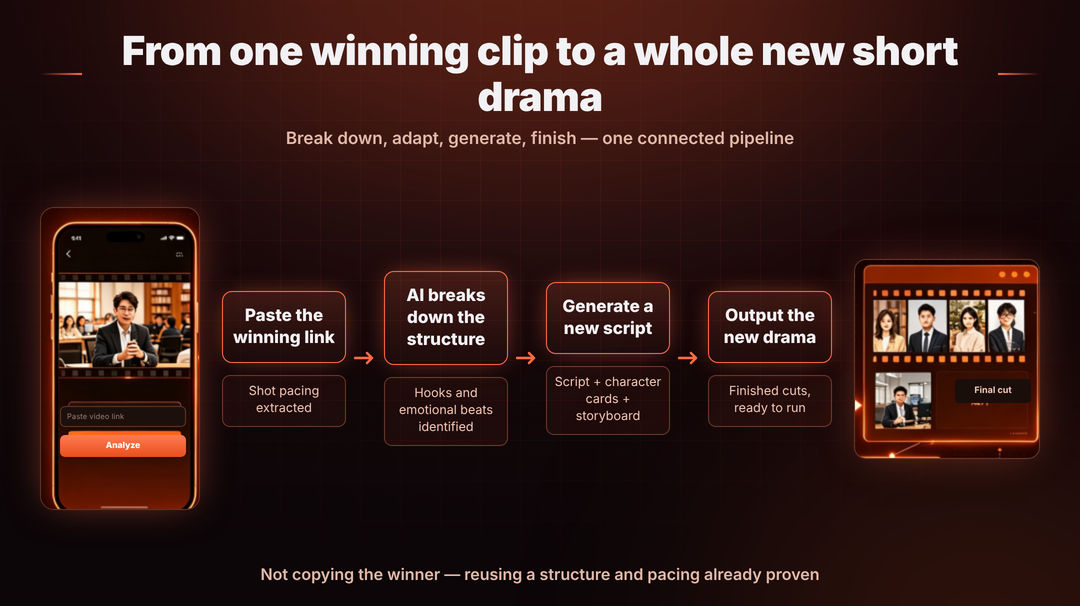
III. Auto-assembly in the test: templates, captions and batch output
Once the rough cut is done, auto-assembly takes over and turns those segments into structurally complete episodes.
In the test we configured one assembly template for a 10-episode drama, containing:
An opener: 3 seconds of brand or series title
Transitions: preset to the pacing of the story (hard cut, dissolve, flash)
Caption styles: dialogue captions, narration captions, selling-point overlays
Background music: matched automatically by emotional section, or specified manually
An end card: follow prompt, next-episode tease
With that configured, Vibbit imports the rough-cut timeline into the template and handles the rest:
Splicing segments in script order and adding transitions, opener and end card automatically.
Generating dialogue captions, timed from the speech recognition results and styled from the template.
Normalising loudness, balancing dialogue, music and effects so levels do not jump around.
Batch output in multiple specifications — 9:16 vertical for short-video platforms, 16:9 for YouTube, 1:1 for feed placements.
After the render task is submitted, Vibbit processes in parallel in the cloud, and assembly for all ten episodes finishes within minutes. Output is named automatically as "episode_resolution_platform," ready to go into review and publishing.
IV. Measured efficiency: from hours to minutes
To show the difference concretely, the test compared the traditional editing workflow with Vibbit's batch rough cut.
The case used was a 10-episode drama with roughly 40 minutes of raw footage per episode — 400 minutes in total.
| Stage | Traditional editing | Vibbit batch rough cut |
|---|---|---|
| Reviewing and filtering footage | approx. 6-8 hours | approx. 30 min (voice location + rule filtering) |
| Rough cut and timeline build | approx. 8-10 hours | approx. 1 hour (automatic rules + manual tweaks) |
| Caption generation and alignment | approx. 3-4 hours | approx. 15 min (auto-generated + proofread) |
| Template application and assembly | approx. 2-3 hours | approx. 10 min (batch cloud render) |
| Total | approx. 20-25 hours | approx. 2-3 hours |
V. Industrialised competition is really about the efficiency of the production system
Short drama has moved past the stage where one hit carries a company. It is now industrial competition on throughput and iteration speed. Whether a series can launch fast, adjust fast and replicate a successful pattern fast depends heavily on the efficiency of the post-production system.
Vibbit's batch rough cut and auto-assembly essentially give a short drama team an automated pipeline where footage goes in and finished episodes come out. It frees editors from filtering and aligning mountains of material so that human creativity concentrates where taste and judgement are actually required: pacing, emotional emphasis, deciding what stays and what goes.
The core of industrialised short drama editing is not letting machines do the creative work — it is letting machines do the repetitive work. Vibbit's batch rough cut and auto-assembly move an editing team from the inefficient model of one person watching one timeline to the efficient model of one person managing a batch of videos. Once production efficiency becomes a competitive moat, a team can put its real attention into good stories and good content, and build a sustainable throughput advantage in a crowded market.