The Efficiency Revolution of Video Content Teams in the Era of Brand Livestreaming
Brand livestreaming has evolved from a marketing experiment into essential infrastructure for normalized business operations.
Brand livestreaming has evolved from a marketing experiment into essential infrastructure for normalized business operations. Whether on domestic platforms like Douyin and Taobao Live, or overseas platforms like TikTok and YouTube, brands are accelerating the development of their own livestreaming capabilities to reduce over-reliance on influencer traffic and establish more stable, controllable sales channels.
However, livestreaming itself is only the front end. What truly determines whether brand livestreaming can succeed in the long run is the back-end content supply capability. The clip videos generated around livestreams, warm-up assets, product explanations, multi-platform adapted versions, and ad testing creatives are consuming content team productivity at a scale far exceeding traditional models.
Competition in the era of brand livestreaming has shifted from "how well you broadcast" on the front end to "whether your content supply can keep up" on the back end. An efficiency revolution is quietly taking place within video content teams.
I. Brand Livestreaming Shifts Video Demand from "A Small Number of Premium Pieces" to "Massive Fragments"
Traditional brand video production is characterized by "a small number of premium pieces." A brand promotional film and a few product demonstration videos can often be reused for months. The production rhythm is slow, but the pressure is manageable.
Brand livestreaming has completely changed this logic. Livestreaming is a high-frequency, continuous content production activity. A brand may broadcast several times a week, with each session lasting several hours, and the resulting video demand erupts in a fragmented, large-scale manner:
Livestream clips: a livestream of several hours needs to be broken down into multiple highlight clips for subsequent distribution and ad placement.
Warm-up short videos: traffic-driving content needs to be released before each livestream to generate attention.
Product explanation videos: each product featured in the livestream requires corresponding demonstration assets.
Multi-platform adaptation: the same content needs to be adapted to different platforms' dimensions, pacing, and subtitle requirements.
Multi-version ad testing creatives: feed ads require a large number of different creative versions for testing and optimization.
When these demands are stacked together, the volume of video content production is several times or even dozens of times that of traditional models. Yet most brand content teams have not made corresponding preparations in their production methods and organizational capabilities.
II. The Efficiency Bottleneck of Traditional Content Teams: Manual Models Cannot Match Batch Demand
Faced with the massive demand brought by brand livestreaming, traditional content teams usually rely on the following working methods, all of which have obvious bottlenecks.
1. Livestream clipping relies on manual labor, resulting in extremely low capacity. Livestream clipping typically requires dedicated staff to review recordings, manually locate highlight segments, and then edit, subtitle, and format them one by one. After one livestream, manual work may only produce a dozen or so clips, while the actual number of segments with distribution value far exceeds that. A large amount of effective material is wasted in inefficient manual screening and editing.
2. Multi-platform adaptation depends on manual adjustment and consumes an astonishing amount of time. Different platforms have different requirements for video dimensions, subtitle positions, and duration pacing. Distributing one video to multiple platforms often requires editors to manually adjust them one by one. When the number of videos increases, this repetitive work takes up a large amount of team time, squeezing out energy that should be spent on creativity and strategy.
3. Material reuse rates are low, and content assets are insufficiently accumulated. Livestreams and shoots accumulate a large amount of raw material, but without systematic organization and rapid processing capabilities afterward, most of this material becomes "dormant assets." The content that brands invest resources to produce cannot be effectively transformed into a reusable asset library, resulting in waste.
4. Creative testing cycles are long, making rapid iteration difficult. Brand livestreaming requires continuous testing of different content directions, but under the traditional production model, each version tested requires re-editing, resulting in long cycles and high costs. Teams often can only place bets based on experience, lacking the data-driven capability for rapid iteration.
The common root of these bottlenecks is that video content production is still stuck in an "artisanal workshop" model, while brand livestreaming requires systematic, large-scale content supply capability.
III. The Essence of the Efficiency Revolution: From "Manual Production" to "Systematic Production"
The efficiency revolution in the era of brand livestreaming is not simply about introducing one or two tools to improve speed at individual points, but about structurally transforming the video content production method.
The core shift is this: separate repetitive, technically intensive, and standardizable steps from manual operation and hand them over to tools and systems, allowing teams to concentrate limited manpower on stages that truly require creativity and judgment.
This systematic production model usually needs to have several characteristics:
Automatic clipping of livestream content: the system automatically identifies highlight segments in livestreams and quickly generates multiple distributable short videos, rather than relying on manual searching and editing one by one.
Batch generation and template-based production: highly standardized content such as product demonstration videos and warm-up videos can be quickly produced through templates and batch tools.
Automatic multi-platform and multilingual adaptation: adaptation work such as dimensions, formats, subtitles, and language is completed automatically by tools, reducing manual repetitive operations.
Data-driven creative reference: by analyzing the structure of high-performing content, provide reference for creative direction and reduce trial-and-error costs.
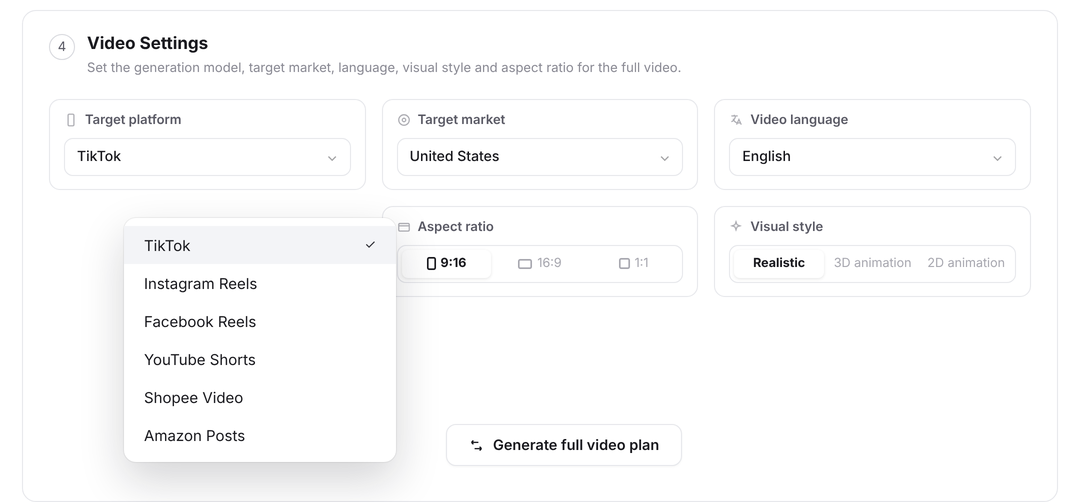
When these capabilities are integrated into a production process, the capacity ceiling of a brand content team is no longer limited by "how many editors there are and how many videos they can cut per day," but is determined by the overall efficiency of the system.
IV. Exploration Directions in Practice
At present, some AI-driven video creation platforms have begun to cover the above needs. They typically integrate multiple stages from editing to distribution, attempting to concentrate capabilities such as livestream clipping, batch generation, and multi-platform adaptation into one workflow. The emergence of such tools provides new options for brand content teams.
Taking Vibbit as an example, its product design philosophy has a certain degree of alignment with brand livestreaming scenarios. Its long-video-to-short-video capability can assist teams in quickly extracting distributable clips from livestream material. Its batch generation and multi-platform adaptation features also help reduce the manual consumption of repetitive operations. Similar tools include other AI video platforms, and together they point in one direction: let tools play the role of "systematic production" infrastructure, and let teams focus on strategy and creativity.
V. The Real Challenge of the Efficiency Revolution: Not Just Tools, but Organizational Capability
The efficiency revolution sounds appealing, but implementation is not simple. Tools are only a lever. The real challenge lies in whether the team has the organizational capability to match.
Brands need to re-examine the role positioning of their content teams: editors are no longer just "people who cut videos," but need to become versatile talents who understand content strategy, data feedback, and tool usage. Team leaders need to shift from "assigning tasks" to "designing processes," establishing a complete closed loop from livestream to clips, from production to distribution, and from testing to iteration.
At the same time, brands need to be wary of a misconception: the efficiency revolution does not mean pursuing "full automation." Content generated by tools still has limitations in creativity and brand texture. If teams rely entirely on tools, it may lead to content homogenization and dilution of brand tone. The correct approach is "human-machine collaboration"—tools are responsible for scale and speed, while people are responsible for direction and quality.
Competition in the era of brand livestreaming is essentially a competition of content supply chain efficiency. Teams that can quickly transform livestream content into multi-platform, multi-version, and multilingual assets, and continuously iterate and optimize, will gain structural advantages in the current environment of high traffic costs.
The core of the efficiency revolution does not lie in which tools are used, but in whether the team can complete the mental leap from "manual production" to "systematic production." Tools can be bought, but process design, organizational capability, and data awareness need to be built by the team itself. This is the most difficult, yet most valuable part of this efficiency revolution.
On the track of brand livestreaming, efficiency is competitiveness. Whoever completes this revolution first is more likely to take the initiative in the next round of competition.