How Do Cross-Border Teams Run Multiple TikTok Accounts with AI Video Tools?
For a cross-border team running several TikTok accounts, the real enemy is not the competition.
For a cross-border team running several TikTok accounts, the real enemy is not the competition. It is scattered throughput and muddled style. A team runs five or six accounts at once, each needing daily posts and each needing to hold its own positioning and visual identity — done entirely by hand, that either exhausts the people or blurs the accounts together. The real value of AI video tools is not generating content automatically but standardising, modularising and making the team's creative capability repeatable. Vibbit's role in this system is a central kitchen: the core team develops content templates and style standards, the AI tool applies them in bulk and produces at speed, and each account's operator only makes local adjustments and publishing decisions. Running multiple accounts is not about making more videos. It is about supporting many personas with one system.
I. The multi-account bind
Start with the reality: a cross-border team on TikTok rarely runs a single account. The common arrangement is a main account for the brand, sub-accounts for vertical categories, regional accounts for localisation, and possibly test accounts for new directions. Add TikTok's weighting of account activity, and every one of them needs posts daily or every other day.
What does that mean in practice? One video per account per day across five accounts is 35 videos a week. If each takes two hours across topic selection, scripting, shooting or sourcing, editing, captions and publishing, that is 70 hours of pure execution a week — before data review, strategy adjustment and cross-region communication.
The outcome is usually one of two things: the team is crushed by the daily cadence and quality slides continuously, or differentiation is sacrificed to protect volume until every account looks stamped from the same mould. What a cross-border team needs is not more people but a toolchain that turns content production into system output.
II. Vibbit's role: from editing tool to production hub
Vibbit is not simply video editing software. In multi-account operations its core value shows up at three levels.
1. Templates as assets: turning the team's best practice into reusable digital property.
Most teams have one or two people who edit well. Their videos have good pacing, consistent style and high conversion. The question is how to turn that individual capability into team capability. Vibbit's templated editing engine decomposes that person's work into a structured template — transition points, caption animations, filter parameters and music beat points all recorded and saved. After that, anyone (a new intern included) can import fresh material, apply the template in one step and produce work close to the original editor's standard.
2. Isolated workspaces per account: one tool managing N independent brands.
Vibbit supports multiple workspaces, one per account, each with its own template library, asset library and export presets. The team can manage accounts with completely different styles in one tool without the basic error of account A's caption style turning up on account B. For a cross-border team it also means workspaces can be divided by region or by category, so each regional lead works only inside their own and neither sees nor needs to care about other accounts' content.
3. Batch processing: turning 35 a week from impossible into routine.
Templates as assets and isolated workspaces solve getting it right; batch processing solves getting it done. Vibbit imports material in bulk, applies templates in bulk, generates captions in bulk and exports different specifications in bulk. One piece of material can derive multiple versions quickly through different templates and caption languages, fitting different accounts' needs. A practised operator with Vibbit producing five to eight finished videos a day is not an exaggerated figure.
III. Building a Vibbit-driven multi-account pipeline
Step one: establish a content hub.
Do not let each account fight its own war. A cross-border team should build a lightweight content hub: a core team (possibly one or two people) developing master content — topic directions, script structures, asset packs, editing templates. The standard those masters must meet is that they can be decomposed, reused and localised.
For example: the team settles on a product unboxing direction, and the core team produces one unboxing template with a fixed shot order (outer packaging close-up → the moment of opening → product from the user's viewpoint → usage demonstration → closing prompt), a fixed caption style and a fixed music character. Once that template is in Vibbit, each regional operator only swaps in localised product material and caption language to produce video suited to their market quickly.
Step two: build a template matrix per account.
Each account builds its own template matrix in Vibbit according to its positioning and audience. One account can rotate two or three core templates: one for product display, one for customer testimony, one for explainers. The templates stay visually consistent with one another — same typeface, same opener and end card, same colour logic — while differing in structure.
The key principle: more templates is not better, more stable is better. A TikTok audience's memory of an account comes from consistency in visuals and pacing. An account that changes style constantly is rebuilding recognition from scratch every time.
Step three: centralise the asset library with tiered permissions.
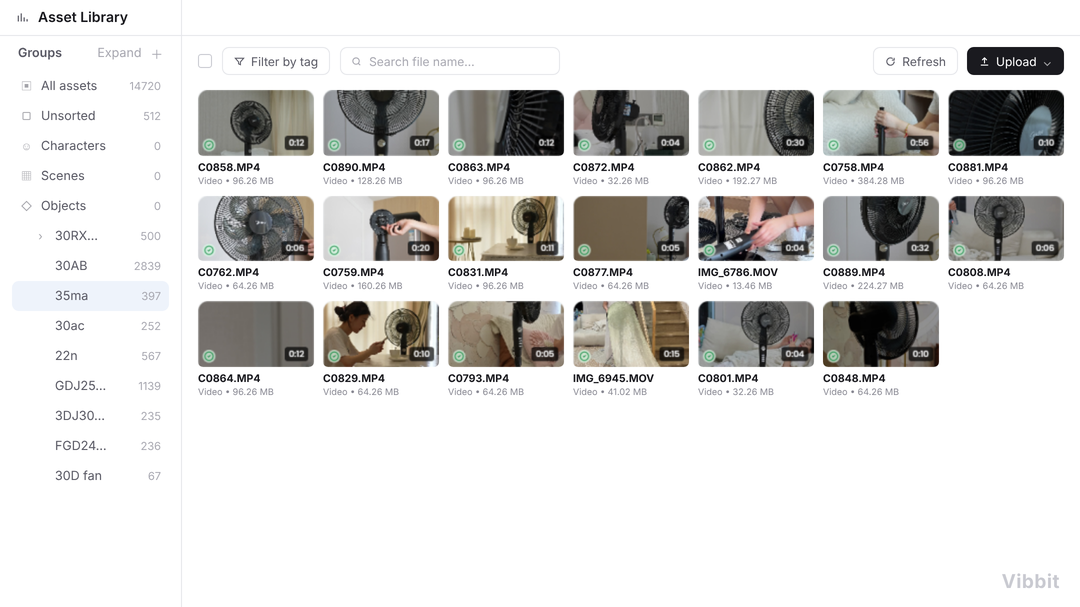
A cross-border team's material comes from many sources: product footage shot in house, user-generated content, official material from suppliers, clips collected online. Vibbit's batch material processing pre-processes all of it consistently: cropping, grading, denoising, resolution unification. Processed material goes into the team's library by category and permission, for each account's operator to call on as needed.
One detail is easily overlooked: naming conventions and tag management. If the library is chaotic, operators can spend longer finding material than editing. Establish strict naming rules and a tag system early; Vibbit's folder management and tag search support it.
Step four: a minimum viable change strategy for localisation.
Localisation is the core challenge for a cross-border team. The same content going to the US, Southeast Asia and the Middle East faces different languages, cultures and expressive conventions. Making video from scratch for every region puts cost out of control. Vibbit's smart captions and multilingual adaptation let a team switch language versions on the same draft — captions translated automatically, voiceover replaceable with local recording, picture structure unchanged.
Minimum viable change means changing only what must change and leaving alone what should not. Language must change, captions must change, but pacing, visual style and content structure stay as they are. That keeps content locally relevant, maintains brand consistency and holds localisation cost inside an acceptable range.
Step five: data feedback and template iteration.
The easiest mistake in multi-account operations is producing without looking. Each account's performance should feed back to the content hub regularly: which templates hold completion rate? Which content directions perform across every region? Which localisation adjustments produced a clear lift?
Vibbit does not do the analysis itself, but it lets a team move faster around the loop of data → insight → template adjustment → bulk application. If a template's completion rate keeps sliding, the core team can change its structure in Vibbit — redesign the first three seconds, change the transition pacing — and apply it in one step to every account using it. That ability to change once and have it take effect everywhere is the heart of multi-account efficiency.
IV. The endgame is systematic capability
Running multiple TikTok accounts is a contest of creative ideas in the short term and of systematic capability in the long term. Can you turn content production into a predictable, repeatable, iterable line? Can a team of five produce like a team of twenty? Can you localise by region while holding brand consistency?
The value of an AI video tool like Vibbit is not how clever it is but that it settles a team's standardised capability into something that can be amplified quickly. Real competitiveness is not in the tool but in how a team uses tools to build its own content production system. Templates go out of date and tools get replaced, but an operating system of hub development, template distribution, local adjustment and data feedback is the underlying capability that keeps a cross-border team alive on the multi-account battlefield.