From Product Photos to Sales Videos: Vibbit's Smart Remix Feature in E-commerce
Most e-commerce teams are sitting on a large stock of good product photography: white-background shots, lifestyle shots, detail shots, model shots.
Most e-commerce teams are sitting on a large stock of good product photography: white-background shots, lifestyle shots, detail shots, model shots. But a photo is static, and in a feed dominated by short video, a static image reaches only so many people. Shooting new video for every product is expensive and slow; stitching photos into a slideshow lacks pacing and does nothing for conversion. Vibbit's smart remix feature exists to resolve exactly that tension: it turns existing product photos into short sales videos that have rhythm, selling points and a clear call to action — making the photos genuinely move, and turning them into content you can run and convert on.
I. Why product photos need to move: the dividend of turning static assets into video
Product photos are the base material of e-commerce operations, but the format no longer matches how people consume content. Audiences on short-video platforms are drawn to motion, and completion and click-through rates are naturally higher than for static images and text. Yet the cost of shooting new video keeps many small and mid-sized sellers on the sidelines.
The value of smart remixing is that it requires no new filming. It reorganises multiple product photos, selling-point copy, background music and transition effects into a short video with real information density and emotional pacing. In essence, Vibbit's smart remix is a "video activation" of photo assets you already own. The product photo stops being something that only lives on a detail page and becomes video content you can distribute, advertise and convert with.
II. The core logic: template-driven pacing plus smart asset matching
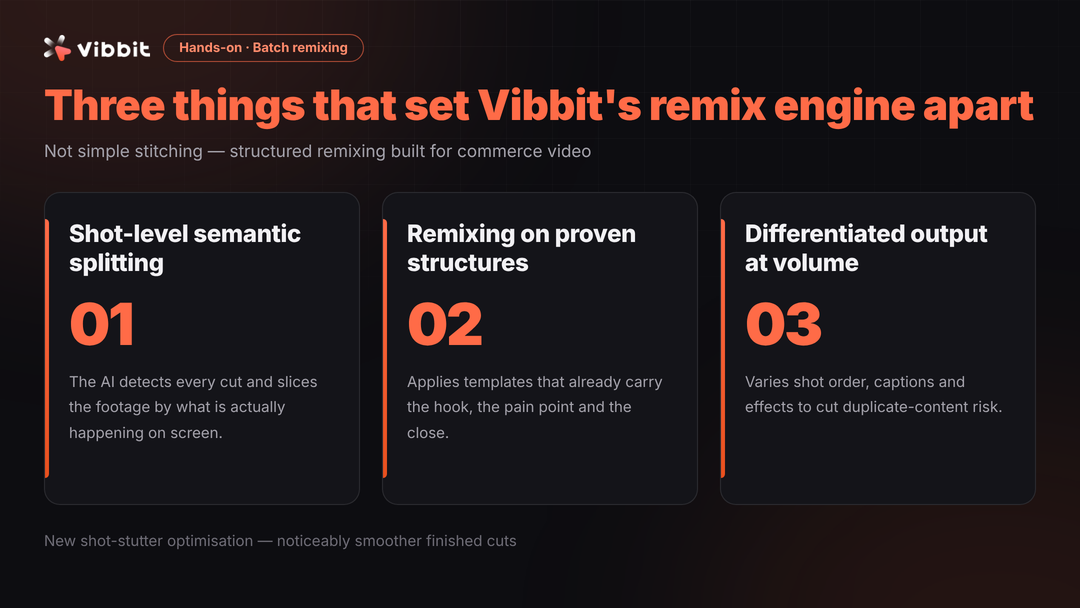
Vibbit's smart remix is not a photo carousel. Its logic has two layers.
Layer one: the template drives the pacing. A sales video needs rhythm — grab attention in the first few seconds, deliver the core selling points in the middle, drive action at the end. Vibbit ships several e-commerce templates, such as "new arrival," "limited-time discount," "clearance sale" and "selling-point focus." Each template has transitions, shot durations, music beats and caption animations built in, and that pacing is controlled centrally by the template, so what comes out has the rhythm of a professionally cut video.
Layer two: assets are matched intelligently. Once you batch-import product photos, Vibbit recognises each image's type and aspect ratio and places it in the right slot in the template. White-background shots suit the product hero moment, lifestyle shots work as atmosphere, detail shots belong where you emphasise a selling point. The system crops, scales and adds safe margins automatically according to preset rules, so nothing gets stretched and no key information is covered.
Together, these two layers turn remixing from manual stitching into intelligent assembly. The operator does not need to know how to edit: pick a template, import the photos, confirm the copy, and a structurally complete sales video is ready within minutes.
III. Three steps from product photo to sales video
Going from photos to a finished sales video in Vibbit usually takes three steps.
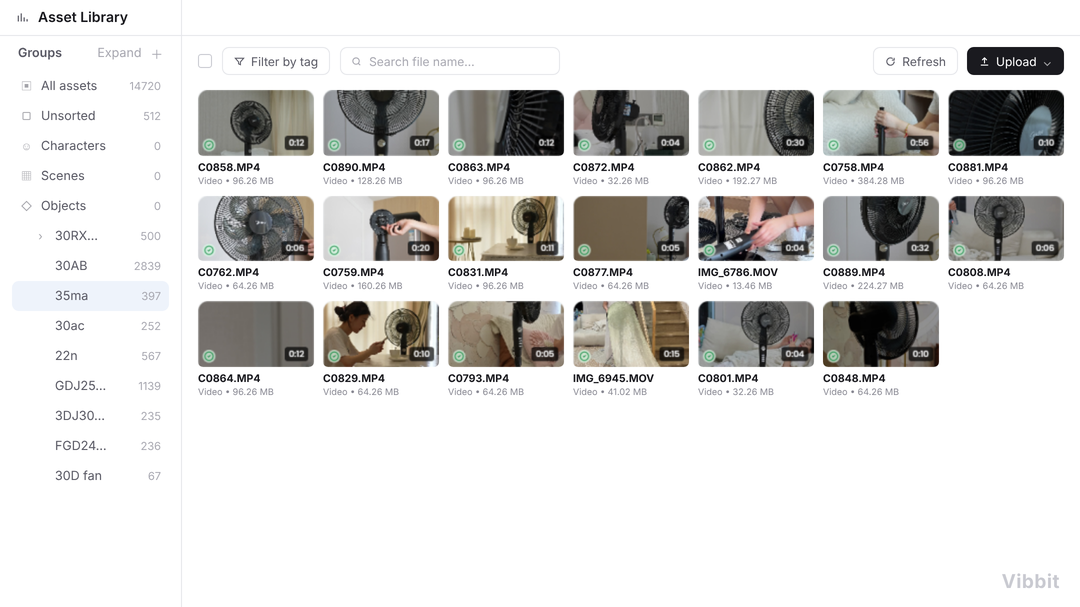
Step one: build a photo library and tag it properly. Organise the photos by type (hero, detail, lifestyle, model) and by SKU, then import them into the Vibbit asset library. The cleaner the tagging, the more accurate the matching later. If you separate "red colourway — lifestyle" from "red colourway — detail," the system will prefer images from the same SKU when remixing, so the copy and the visuals never contradict each other.
Step two: choose a template and bind the selling-point copy. Pick the template that matches your goal, then fill the template's text areas with product name, core selling points, price information and call to action. Vibbit lets you bind copy to a data table, so if a series has many SKUs you can import the copy in bulk and let the system swap it in.
Step three: generate with one click, then fine-tune. Once the task is submitted, Vibbit composites the video in the cloud — image switching, transitions, music beats, caption timing. You can preview the result and adjust the order of individual photos, the dwell time on a line of copy, or the background music, then export and publish.
The point of the whole process is this: the photos do not need to be reshot, editing does not need to be learned from scratch, and videos at volume do not need to be made one at a time.
IV. Details that decide whether a remix actually sells
A remix video can be produced fast. A remix video that actually sells takes care in the details.
Something useful has to appear in the first 3 seconds. Do not open on a brand logo or an empty establishing shot. Vibbit's templates let you customise the opening frame; make the first image the most visually arresting lifestyle shot or a bold statement of the offer, so the viewer knows within three seconds what this is and what is in it for them.
Selling-point copy should be short and concrete. Each line in a remix is on screen only briefly, so it cannot read like a detail page. Keep each selling point to roughly five to eight words — "light, no sweat," "R$100 straight off," "buy one get three." Vibbit's smart captions adjust display duration to the length of the line, but the operator still has to control that length in the data table.
Align image switching with the music beats. Pacing is the advantage of smart remixing, but if you import too few photos, the system will repeat images or stretch dwell times to fill the runtime, and the pacing goes slack. Prepare 5 to 8 photos from different angles or scenes for every 15-second video so the transitions have enough material behind them.
The ending needs an explicit instruction. Whether it is "tap the link below," "buy now" or "visit the store for a coupon," the closing CTA cannot be dropped. Vibbit's templates reserve a closing action area — fill it with a clear, compliant instruction appropriate to the channel you are publishing on.
V. Make every product photo a video asset
Competition in e-commerce has moved to content efficiency. Product photography is a cost the brand has already paid; smart remixing is how that asset gets used a second time and its value multiplied. The value of Vibbit's smart remix is not that videos "generate themselves" — it is that it releases e-commerce teams from the anxiety of not having video assets, and lets them build a testable, iterable, scalable video system out of the photos they already have.
The central idea comes down to one sentence: in e-commerce, smart remixing is not there to replace creativity but to release the video potential of product photos in a structured way, so that every photo can be the starting point of an effective sales video. Once templates, data and the asset library form a closed loop, video production evolves from an artisanal workshop into a content assembly line — and the team's real attention can go back to understanding what customers need and how conversion actually works.