From Artisanal Workshop to Content Factory: How E-commerce Teams Build a Video Content Hub with Vibbit
What an e-commerce content team faces every day is not "should we make video" but "how many, how fast, and for how many channels."
What an e-commerce content team faces every day is not "should we make video" but "how many, how fast, and for how many channels." A single winning product may need a dozen different formats at once — hero-image video, feed cut-downs, livestream highlights, creator remixes, store banner video. If every one of them depends on an editor starting from scratch, throughput hits its ceiling fast. That is exactly where Vibbit earns its place: it is not simply an editing tool but a video content hub that accumulates, reuses and automates. When an e-commerce team builds a hub on Vibbit, what really happens is that video production capability — scattered across personal laptops, cloud drives and editing software — gets upgraded into a shared, standardised assembly line with batch production and one-click distribution.
I. Why an e-commerce team needs a video content hub
Video production in most e-commerce teams suffers from three classic problems: assets are scattered, the workflow is fragmented, and the same work is repeated. After a livestream, the recording sits in the cloud and nobody breaks it down. A winning short video has to be exported all over again just to change aspect ratio. An operator asking an editor for a five-second selling-point clip may wait half a day.
A content hub pulls all of that into one system, so assets are visible, templates are reusable, production is collaborative and distribution is traceable. Vibbit provides exactly that infrastructure: a cloud asset library that holds raw video, images, music and subtitles in one place; online collaboration so operations, editing, media buying and design all work inside the same project; and API and automation capability that hands repetitive editing to the machine.
II. What Vibbit is for: from asset management to intelligent production
Vibbit is not positioned to replace professional editing software. It is the central kitchen for e-commerce video. A few key modules do the work.
Cloud asset library with smart tagging. Everything uploaded — shot footage, livestream recordings, creator material, UGC — is tagged, categorised and made searchable automatically. An operator looking for "every voiceover clip for this product in the last 30 days" no longer has to dig through chat logs and cloud drives.
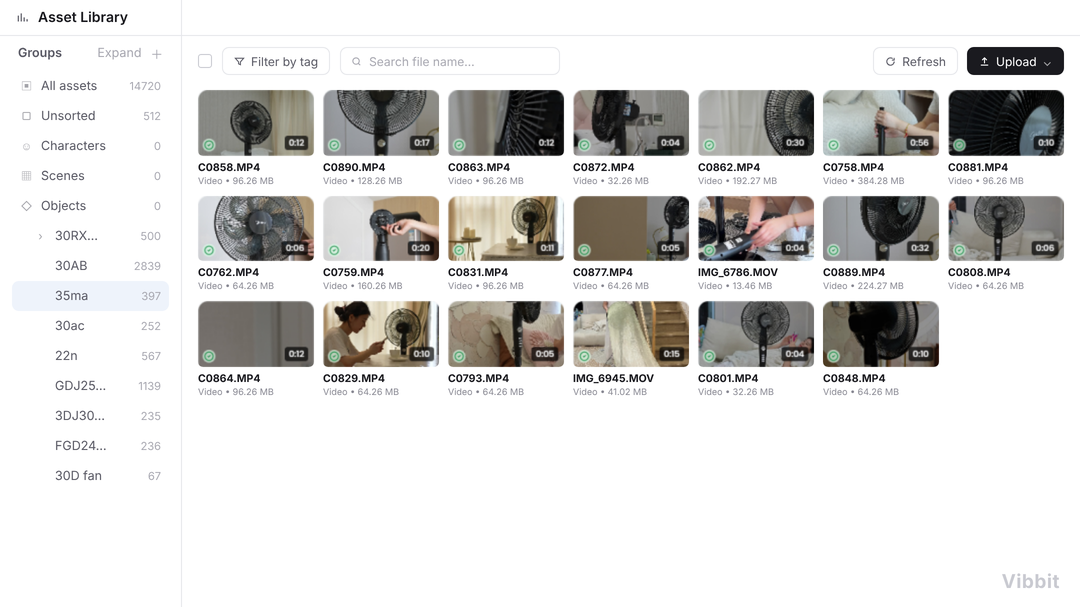
Templated video packaging. Brand standards, openers and end cards, caption styles, corner marks and stickers become reusable templates. An editor swaps the visuals and the copy and the whole channel mix stays visually consistent.
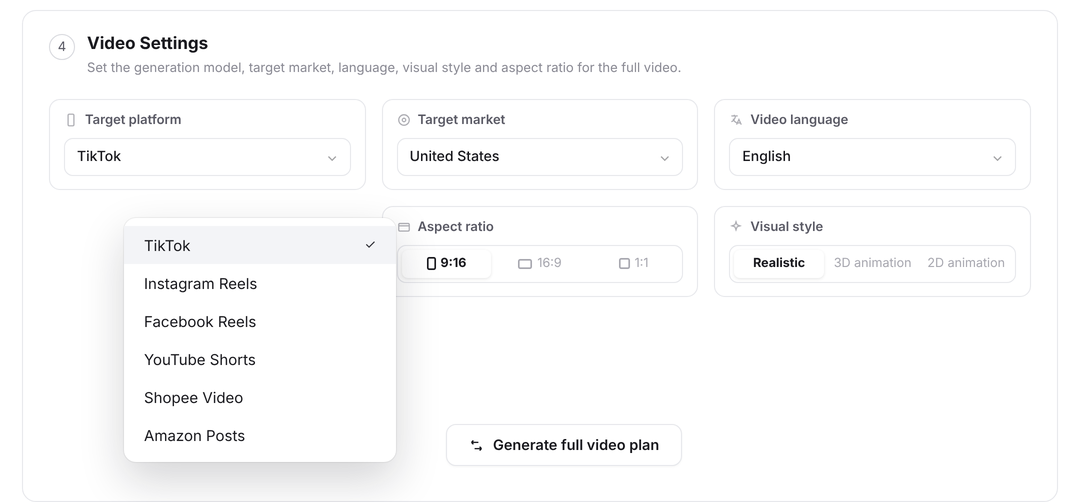
Batch rendering and multi-format output. One video automatically produces 9:16, 16:9, 1:1 and other ratios to suit different platforms.
Smart cut-down and highlight detection. Using speech recognition and visual analysis, the system pulls the valuable segments out of a long video and turns them into short-form material — particularly useful for livestream clipping and voiceover edits.
API and automated workflows. Connect the product catalogue, order system or ad platform through the interface and you get scenarios like "a new product automatically generates its base video" or "material is swapped automatically once performance data comes back."
III. Batch production: templates plus API make video flow like product
The key to producing e-commerce video at volume is not editing speed but degree of standardisation. Vibbit's approach is template first, parameters driving, machine executing.
Take a beauty brand launching 20 SKUs a week, each needing one 15-second hero video and three feed assets. Traditionally an editor finds material, grades, captions and exports for each product separately, finishing three or four a day at best. With Vibbit, the team spends a day building a hero-video template with shot order, transition pacing, caption position, brand corner mark and background music all preset. After that, you fill product images, selling-point copy and price into a form, and Vibbit matches footage or rendered clips from the asset library and batch-renders against the template. Connect the product hub through the API and a new SKU can even trigger video production, with the operator approving it before it uploads to the asset library and the ad platform. The average production time per video drops from 40 minutes to 5, lifting throughput five to eight times.
IV. Smart distribution: produce once, adapt everywhere, feed data back
Producing the video is only step one; distribution and iteration matter just as much. Vibbit's distribution capability works on two levels.
One-click multi-channel publishing with format adaptation. From one source video, Vibbit generates versions suited to each platform — a vertical cut with trending-tag captions for short-video feeds, a hero-image video emphasising product detail for marketplaces, a cover with headline text for discovery platforms, a duration- and pace-controlled version elsewhere. Instead of asking an editor to export variants over and over, operations tick the channels in the hub and the system handles transcoding, cutting, watermarking and title changes.
Data flowing back to drive iteration. Vibbit can connect to platform data interfaces and bring views, completion rate, click-through rate and conversion rate back into the hub. The team sees clearly which openings hold attention, which selling-point segments convert, which templates scale. From that feedback, operations adjusts templates or asset priority — and can even let the system replace underperforming material automatically — closing the loop from production to distribution to data to optimisation.
V. How to get there: from a single win to an organisation-level hub
A team does not need to build the whole thing at once. Three stages work well.
Stage one: turn assets into property. Upload all historical material, livestream recordings and product video into the Vibbit cloud library and establish a tagging system so the team can find what exists. The goal here is simply: stop reshooting, stop losing things.
Stage two: standardise templates. Pick the video types you need most — hero video, feed cut-downs, livestream teasers — and settle three to five high-converting templates inside Vibbit. The editor shifts from cutting videos to tuning templates, and batch capability starts to form.
Stage three: automate and let data drive. Connect the product hub, ad system and dashboards through the API so new products trigger production, campaigns swap assets automatically and data returns on its own. At this point the video hub genuinely becomes business infrastructure, and content production turns from a cost centre into a growth engine.
Competition in e-commerce ends in a competition of efficiency. While others are still cutting videos one at a time, the team that has built a video content hub on Vibbit has already broken the logic of a winner down into templates, handed the repetition to machines and put human attention back on creativity and strategy. What Vibbit offers is not a faster pair of scissors but a content supply chain. Behind batch production and smart distribution lies a redefinition of the video asset: video is no longer a consumable but a reusable, traceable, optimisable digital asset. That is the real central idea of an e-commerce content hub.