AI Batch Editing: Is It Reliable? An E-commerce Video Team's Test Report
The term "AI batch editing" has been a hot topic in the e-commerce circle for two years.
The term "AI batch editing" has been a hot topic in the e-commerce circle for two years. Some say it's an efficiency revolution—producing 50 videos in 10 minutes is no dream; others say it's a gimmick, generating videos that all look the same and get no traffic when published. What's the truth? Our team conducted a two-week test using Vibbit, laying out the real data and the pitfalls we encountered, to serve as a reference for peers still on the fence.
Whether AI batch editing is reliable depends not on the tool itself, but on whether you use it in the right scenarios with the right processes. In the field of standardized product short videos, Vibbit is a reliable productivity lever, but it is not an "automatic money printer"—it requires human oversight of strategy and quality.
Our test conclusion, put upfront: reliable, but with boundaries. Below, we reconstruct the real testing process from four dimensions: efficiency, quality, data feedback, and pitfall avoidance.
1. Test Background: Why We Were Skeptical About AI Batch Editing
We are a 5-person e-commerce content team responsible for product short videos across 3 stores and about 200 SKUs. Previously, we relied entirely on manual editing—one person could produce at most 15 videos a day. During major promotions, even with everyone working overtime, we couldn't keep up with demand.
Our skepticism about AI batch editing mainly had three points: first, we worried the generated quality would be too poor and drag down account authority when published; second, we worried that batch templates would make all videos look identical, causing users to swipe away; third, we worried that the data feedback loop would be broken, forcing us to rely on manual work for optimization and iteration.
With these three questions in mind, we chose Vibbit for a two-week test. The test scenarios were two product categories—snacks and home goods—with the goal of producing 50 publishable product short videos per day, covering three channels: Douyin, Taobao Browse, and Pinduoduo.
2. Efficiency Test: Is "50 Videos in 10 Minutes" Marketing Hype or Real Capability?
First, the result: 50 videos in 10 minutes is real, provided you are well-prepared.
Before the test, we spent half a day setting up templates and the asset pool. Vibbit supports CSV import, so we directly exported product data from our ERP—including product names, main image links, selling point copy, and prices—and mapped them to the corresponding template positions in one go. This step is the key to efficiency: once the upfront configuration is done, the rest is just "one-click generation."
On test day, after clicking "Generate All," the rendering time for 50 15-second vertical videos was about 6 and a half minutes. Including export and file organization, the total time was around 9 minutes. Moreover, Vibbit supports simultaneously outputting 9:16, 1:1, and 16:9 aspect ratios, which means generating 150 publishable pieces of content in one go, with almost zero manual effort.
But there is a prerequisite here: if your materials and copy are not organized into a spreadsheet in advance, and you have to manually upload images and type text every time, then 10 minutes is just an illusion. Vibbit's efficiency leverage is built on a "data foundation." This is why we emphasize SOP and upfront preparation.
3. Quality Test: Can Visuals, Subtitles, and Voiceover Pass the Minimum Bar?
No matter how efficient, if quality doesn't pass, it's all for nothing. We conducted strict checks from three dimensions.
Visuals and cropping. Vibbit's smart cropping performed stably in 9:16 vertical, keeping the product subject within the safe area at all times, with no instances of key information being cut off. When outputting multiple aspect ratios, the square and horizontal versions also correctly rearranged elements without manual adjustment. The only thing to note is that if the source material itself is too tightly composed or lacks sufficient resolution, the edges may look a bit cramped after cropping—this is a problem on the material side, not the tool side.
Subtitles and voiceover. The accuracy of automatic subtitles was higher than we expected. Chinese copy had virtually no typos, and numbers and brand names were recognized correctly. For AI voiceover, we selected two voices—"young female" and "calm male"—with moderate speed and synchronization with subtitles. However, with longer copy, the voiceover pace became slightly tight. We recommend keeping each voiceover script under 30 characters for the most natural effect.
Template differentiation. This is the "cookie-cutter" issue many worry about. We used 5 different opening hook templates (question-style, number-impact-style, scene-immersion-style, etc.) alternately, paired with different background music. The 50 batch-generated videos did not show an obvious "copy feeling" to the naked eye. Of course, to make content truly distinctive, the template library needs continuous updating—you can't use one set forever.
4. Data Feedback Test: Can Batch-Produced Videos Actually Perform?
Production is only the first step; whether the videos can generate data is the ultimate criterion for verifying "reliability."
We published the Vibbit-generated videos to three channels, accumulating over 600 posts in two weeks, tracking views, click-through rates, and conversion rates. The results fell into two phases:
Week 1 (testing phase): The overall data was mediocre, with average views only about 70% of manually edited videos. Upon review, we found the problem was not the tool but our strategy—we used the same set of selling point copy without differentiating by channel characteristics, and the opening hook test samples were too scattered to determine which was more effective.
Week 2 (optimization phase): Based on data feedback, we went back to the CSV spreadsheet and batch replaced all products with the best-performing "number-impact-style opening" and "limited-time offer" copy, while fine-tuning copy length for each channel. Vibbit regenerated the optimized versions within minutes. This week's data improved significantly—average click-through rate was 38% higher than Week 1, and some hit videos even outperformed manually fine-tuned control samples in conversion rate.
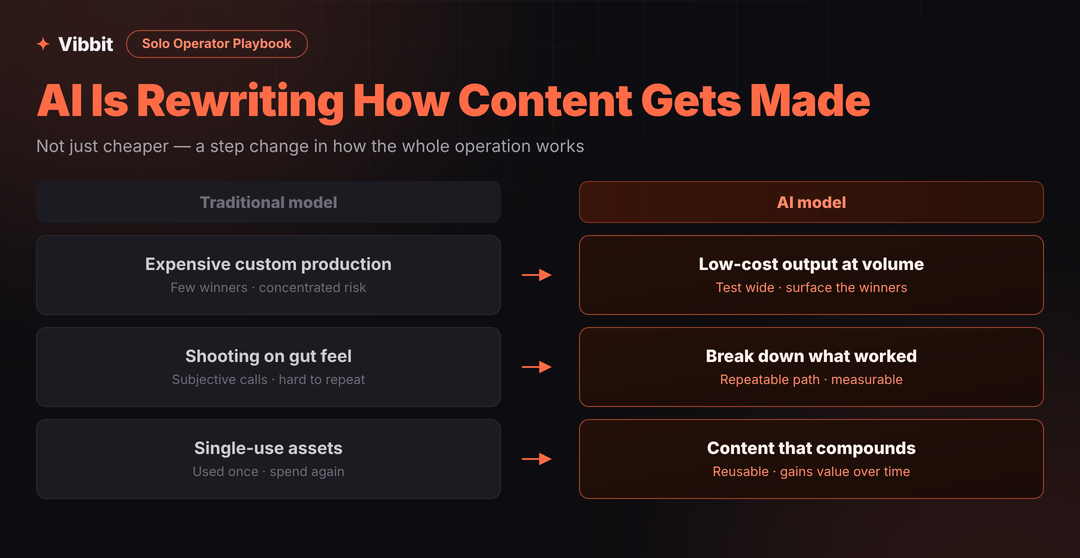
This result validated our core judgment: the true value of AI batch editing lies not in "production" but in "rapid trial and error." Manual editing can test only 5 types of openings in a week; Vibbit can test 50 in a day and then quickly scale up the effective strategies. This is an iteration speed that manual work cannot match.
5. Conclusion: Whether AI Batch Editing Is Reliable Depends on How You Use It
Back to the title question, our test answer is:
In standardized, template-friendly product short video scenarios, AI batch editing tools like Vibbit are reliable and can significantly improve a team's production efficiency and iteration speed. It is not a gimmick but a real productivity tool that can be implemented in daily e-commerce work.
But it has clear boundaries. If you expect it to replace human creativity, automatically produce viral hits, and allow you to completely hands-off, you will surely be disappointed. Its best role is as an "efficiency lever": compressing repetitive labor to a minimum and letting the team focus on product selection, copy strategy, and data analysis.
The formula for reliability is: Vibbit's automation capability + the team's structured thinking + strict SOP checkpoints + a data-feedback-driven iteration habit. All four are indispensable.
For e-commerce teams still on the fence, our advice is: don't blindly believe just because "AI batch editing" sounds too good to be true, and don't refuse to try it out of concern for quality. Pick a small category, run a small-batch test, and let the data speak. Two weeks is enough time to judge whether it is truly reliable.