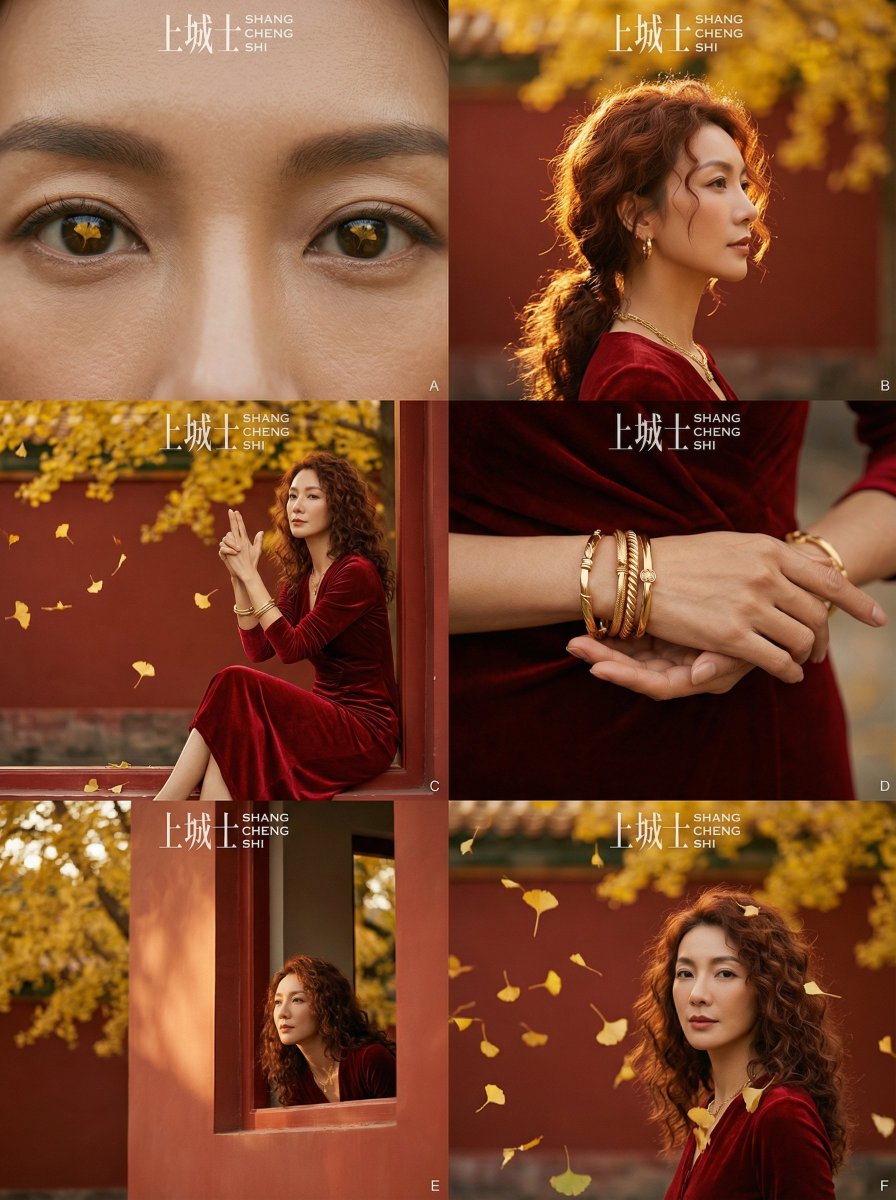
Cinematic Chinese Style Fashion Editorial (Shang Cheng Shi)
Social Media Post
An extremely detailed Nano Banana Pro prompt designed to replicate the style of a high-end fashion editorial (Shang Cheng Shi), specifically referencing actress Zhao Lusi. It demands 100% strict prese
Prompt
As a world-class fashion photographer (Steven Meisel / Paolo Roversi / Harley Weir style), shoot a brand-defining autumn Chinese-style fashion editorial for "SHANG CHENG SHI" featuring **[100% strict restoration of facial features, hairstyle, and temperament from Reference Image 1]**. The film focuses on cinematic close-ups and textural details, integrating Oriental framing aesthetics with contemporary avant-garde fashion language. [Core Character Restoration] Strictly referencing Reference Image 1: Facial Features: 100% restoration of facial proportions, eye shape, nose shape, lip shape, and facial contours. Hairstyle: Reddish-brown large wavy curls (fluffy and soft texture, matching the warm autumn tone). Temperament: Gentle, relaxed, and elegant Oriental female feeling, but allowing the following artistic adjustments: Makeup can be more cinematic (retaining natural base makeup, enhancing the dramatic effect of the eyes). Hair dynamics can show natural flow due to the autumn wind. Emotional expression can increase cinematic narrative tension based on "gentle gaze." [In-depth Analysis of Brand DNA - Reference Image 2] Interpretation of "SHANG CHENG SHI" brand archetype: Cultural Gene: Collision of Oriental classical aesthetics and contemporary fashion refinement. Aesthetic Core: The passionate romance of vermilion red + the gentle poetry of ginkgo gold + the Oriental narrative of red wall framing. Target Audience Lifestyle: Urban women pursuing "relaxed elegance," loving Chinese-style atmosphere and exquisite dressing, yearning for the aesthetic of "expressing contemporary attitude within classical artistic conception." Brand Visual Language: High-saturation vermilion red as an emotional anchor. Ginkgo autumn as a seasonal symbol system. Vintage gold jewelry as a carrier of refinement. Red wall framing as the Oriental composition philosophy. [Narrative and Composition - Cinematic Multi-Lens Language] Group 1: Strong Portrait Close-up (Cinematic Facial Narrative) Shot A - Eye Close-up: Focuses on the eyes and upper face at extremely close range. The gaze penetrates the lens, conveying the power of a "gentle yet firm" Oriental woman. Emphasis: The golden ginkgo light reflected in the pupils. The detailed texture of individual eyelashes. The natural tension of the subtle expression muscles around the eyes. The blurred halo of the vintage gold necklace on the neck. Shot B - Side Profile Close-up: 45-degree side angle, capturing the perfect contour line from the forehead → nose bridge → lips → jawline. Reddish-brown curls drape behind the ear, with some strands outlined by the autumn backlight in gold. The background is a color clash of blurred vermilion red walls and golden ginkgo. Group 2: Body Language and Emotional Posture (Cinematic Narrative Composition) Shot C - Full View of Chin Resting (Integrating Extreme Foreground Hand Stack Pose): [Core replication shot of Reference Image 2] The person sits curled up sideways on the red wall window ledge, resting their chin, with soft and relaxed body lines. But adding cinematic texture and specific hand movements: The pose must precisely replicate the extreme foreground hand stack, with strict geometric and physical support: Two arms fully extended forward towards the camera (straight forearms, straight wrists, rigid extension), creating a strong sense of depth. Foreground Hand #1 (Lower Supporting Tray): The lower hand is pushed closest to the lens and held horizontally like a small table. The back of the hand faces the camera, while the palm lines face upward towards the ceiling (true palm-up direction). Fingers are fully extended and forcefully spread to maximum span, with visible tension in the knuckles/tendons; the palm surface is flat like a platform; the base of the palm appears huge due to proximity. Physical Contact Constraint: Foreground Hand #2 must be supported by and pressed onto Foreground Hand #1—a clear "placed on a tray" relationship, with visible contact shadows and slight compression/indentation in the contact area (no floating separation). Foreground Hand #2 (Center Aiming Finger Gun): A rigid straight aiming finger gun sits on the tray palm, placed dead center in the frame and aligned with the camera axis like an aiming pistol. The wrist and forearm are fully straight; the index finger points directly at the lens (or slightly upward), the thumb is extended, and the other fingers are tightly curled. This aiming hand obscures about half of the face (covering one eye/cheek area); only one eye is clearly visible and sharply focused, maintaining strong eye contact through/around the hand. Head & Gaze: Subtle head tilt (aiming posture), eyes locked on the lens. Simultaneously integrating the chin-resting element, making the overall posture blend relaxed elegance: The draped folds of the vermilion red fitted long dress show a delicate velvet-like texture in the light and shadow; the gold bracelet forms exquisite light spots on the wrist; falling ginkgo leaves form natural occlusion in the foreground (increasing depth of field layers); within the red wall frame, the golden ginkgo tree is presented in soft focus, creating an "image within an image" Oriental aesthetic. Shot D - Hand Detail Close-up (Integrating Extreme Foreground Hand Stack Pose): Tight crop: Slender fingers lightly touch the cheek, and vintage gold bracelets stack on the wrist. But the focus is locked on the extreme foreground hand stack details: Two arms fully extended forward towards the camera (straight forearms, straight wrists, rigid extension), creating a strong sense of depth. Foreground Hand #1 (Lower Supporting Tray): The lower hand is pushed closest to the lens and held horizontally like a small table. The back of the hand faces the camera, while the palm lines face upward towards the ceiling (true palm-up direction). Fingers are fully extended and forcefully spread to maximum span, with visible tension in the knuckles/tendons; the palm surface is flat like a platform; the base of the palm appears huge due to proximity. Physical Contact Constraint: Foreground Hand #2 must be supported by and pressed onto Foreground Hand #1—a clear "placed on a tray" relationship, with visible contact shadows and slight compression/indentation in the contact area (no floating separation). Foreground Hand #2 (Center Aiming Finger Gun): A rigid straight aiming finger gun sits on the tray palm, placed dead center in the frame and aligned with the camera axis like an aiming pistol. The wrist and forearm are fully straight; the index finger points directly at the lens (or slightly upward), the thumb is extended, and the other fingers are tightly curled. This aiming hand obscures about half of the face (covering one eye/cheek area); only one eye is clearly visible and sharply focused, maintaining strong eye contact through/around the hand. Head & Gaze: Subtle head tilt (aiming posture), eyes locked on the lens. Emphasize the contrast between the fine texture of the metal chain and the warm texture of the skin; the detail of the warp and weft lines of the vermilion red cuff fabric; the natural luster of the nails; the background is blurred into abstract color blocks of vermilion red and gold. Group 3: Environmental Atmosphere and Oriental Framing (Cinematic Scene Narrative) Shot E - Red Wall Framed Mid-shot (Integrating Extreme Foreground Hand Stack Pose): Using the red wall window frame as a natural frame, the person is centered within the frame. The composition follows the Oriental philosophy of "framing into a picture," but the lighting treatment has the high contrast of European cinema, and integrates the hand pose: The pose must precisely replicate the extreme foreground hand stack, with strict geometric and physical support: Two arms fully extended forward towards the camera (straight forearms, straight wrists, rigid extension), creating a strong sense of depth. Foreground Hand #1 (Lower Supporting Tray): The lower hand is pushed closest to the lens and held horizontally like a small table. The back of the hand faces the camera, while the palm lines face upward towards the ceiling (true palm-up direction). Fingers are fully extended and forcefully spread to maximum span, with visible tension in the knuckles/tendons; the palm surface is flat like a platform; the base of the palm appears huge due to proximity. Physical Contact Constraint: Foreground Hand #2 must be supported by and pressed onto Foreground Hand #1—a clear "placed on a tray" relationship, with visible contact shadows and slight compression/indentation in the contact area (no floating separation). Foreground Hand #2 (Center Aiming Finger Gun): A rigid straight aiming finger gun sits on the tray palm, placed dead center in the frame and aligned with the camera axis like an aiming pistol. The wrist and forearm are fully straight; the index finger points directly at the lens (or slightly upward), the thumb is extended, and the other fingers are tightly curled. This aiming hand obscures about half of the face (covering one eye/cheek area); only one eye is clearly visible and sharply focused, maintaining strong eye contact through/around the hand. Head & Gaze: Subtle head tilt (aiming posture), eyes locked on the lens. The illuminated side of the red wall shows a rough granular texture; the edge of the window frame forms a hard light-dark boundary; the person is illuminated by soft diffused light (from the ginkgo reflection); the background ginkgo ancient building forms an abstract golden-yellow atmosphere outside the depth of field. Shot F - Falling Ginkgo Leaves Dynamic (Integrating Extreme Foreground Hand Stack Pose): Captures the moment ginkgo leaves fall in the air, with clear leaves in the foreground, sharp focus on the person's half-body in the mid-ground, and the background red wall and ginkgo tree completely blurred. Conveys "autumn flow" and "temporal poetry." Integrates the hand pose: The pose must precisely replicate the extreme foreground hand stack, with strict geometric and physical support: Two arms fully extended forward towards the camera (straight forearms, straight wrists, rigid extension), creating a strong sense of depth. Foreground Hand #1 (Lower Supporting Tray): The lower hand is pushed closest to the lens and held horizontally like a small table. The back of the hand faces the camera, while the palm lines face upward towards the ceiling (true palm-up direction). Fingers are fully extended and forcefully spread to maximum span, with visible tension in the knuckles/tendons; the palm surface is flat like a platform; the base of the palm appears huge due to proximity. Physical Contact Constraint: Foreground Hand #2 must be supported by and pressed onto Foreground Hand #1—a clear “placed on a tray” relationship, with visible contact shadows and slight compression/indentation in the contact area (no floating separation). Foreground Hand #2 (Center Aiming Finger Gun): A rigid straight aiming finger gun sits on the tray palm, placed dead center in the frame and aligned with the camera axis like an aiming pistol. The wrist and forearm are fully straight; the index finger points directly at the lens (or slightly upward), the thumb is extended, and the other fingers are tightly curled. This aiming hand obscures about half of the face (covering one eye/cheek area); only one eye is clearly visible and sharply focused, maintaining strong eye contact through/around the hand. Head & Gaze: Subtle head tilt (aiming posture), eyes locked on the lens.